Audi Key Replacement Decoder: Which Immobilizer Generation Is Yours?
As of August 2026, an Audi spare key in the DFW market runs roughly $200–$450, and an all-keys-lost job runs $500–$900 — but that spread is almost entirely explained by one thing most quotes never mention: which immobilizer generation your car is on. A 2008 A4 and a 2018 A4 wear the same badge and are not remotely the same job.
Audi has run four distinct security architectures on cars still driving around Arlington and the wider metroplex. Knowing which one you have tells you in advance whether your key is a forty-minute driveway job or a two-hour procedure that may involve removing a module. This guide is the decoder.
The four generations, in plain terms
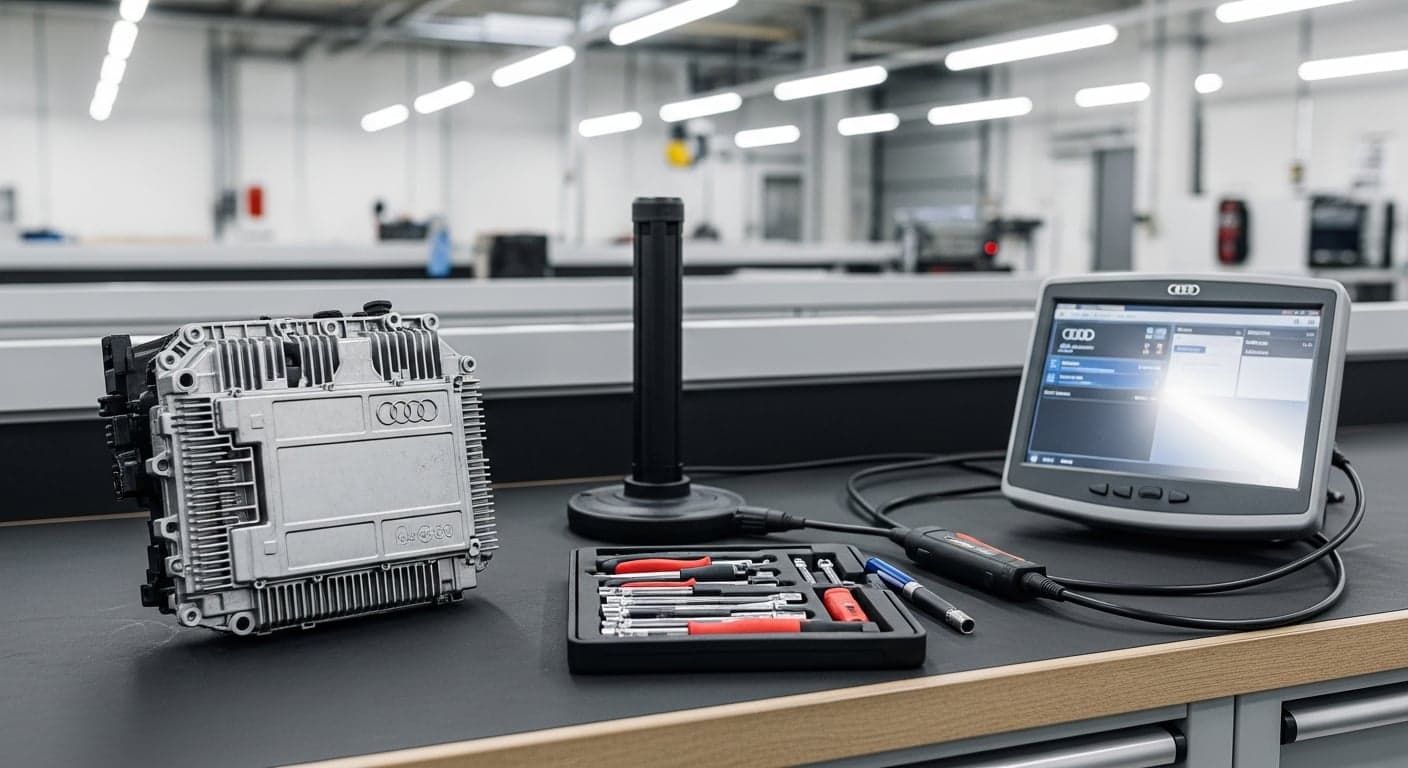
Audi's immobilizer is not a single box. It is an agreement between several modules — the instrument cluster, the engine ECU, the gateway, and on keyless cars the Kessy module — about which transponder is allowed to start the engine. What changed between generations is where the authorising data lives and how hard it is to reach when no key exists.
| Generation | Rough model years | Where security data lives | Transponder | All-keys-lost difficulty |
|---|---|---|---|---|
| IMMO 3 | 1997–2005 | Instrument cluster | ID48 (Megamos crypto) | Low — cluster-based, well documented |
| IMMO 4 | 2005–2010 | Instrument cluster over CAN | ID48 | Low to moderate |
| IMMO 5 | 2009–2016 | Split: cluster + ECU + Kessy | ID48 / Megamos AES | Moderate to high |
| MQB / MLB | 2013–2026 | Distributed; BCM2 on MLB models | Megamos AES | High — often bench-level |
IMMO 3 — 1997 to roughly 2005
The B6 A4, C5 A6, first-generation TT and their contemporaries. Security lives in the instrument cluster and is protected by a login code. This is the friendliest generation to work on: a spare key is straightforward, and even all-keys-lost is a known quantity for a shop with the right tooling.
What this means for you: cheapest Audi key work available. Spare keys typically land at the low end of the range. The main complication on these cars is age — a cluster that has been swapped at some point in twenty years may not match the ECU, and that has to be sorted before any key will program.
IMMO 4 — roughly 2005 to 2010
The B7 A4, C6 A6, first Q7 and the early A5. Still cluster-centred but now communicating over CAN, and this is the era where Audi's keyless-start system (Kessy) begins appearing on higher trims.
What this means for you: still very workable. The dividing line inside this generation is Kessy. A blade-and-remote car is simple; a car with a proximity fob and a start button adds the Kessy module to the conversation and adds time.
IMMO 5 — roughly 2009 to 2016
The B8 A4, C7 A6, 8P/8V transitional A3s, first-generation Q5. This is the generation where Audi stopped keeping the security picture in one place. The authorising data is split across the cluster, the engine ECU and — on keyless cars — the Kessy module, and the modules cross-check each other.
This is also where component protection becomes a real consideration. Component protection is Audi's anti-theft measure for control modules: a module pulled from another car will refuse to function until it is adapted to the new vehicle, and that adaptation runs through the factory's online system.
What this means for you: a spare key with one working original is still a normal appointment. All-keys-lost is where the price and the time step up, because the data has to be gathered from more than one place.
MQB and MLB — 2013 to 2026
MQB is the transverse platform (A3 8V onwards, and the Volkswagen models that share it). MLB and MLB Evo are the longitudinal platform — B9 A4, A5, C8 A6, A7, A8, second-generation Q5, 4M Q7 and Q8.
Two things define this era. First, the transponder moved to Megamos AES, a genuinely modern cipher. Second, on MLB cars the security role largely moved into the BCM2 module, and reaching its data with no working key frequently means the module comes out of the car and goes on the bench.
What this means for you: with a working key, a spare on most MQB/MLB Audis is still an at-the-car job. Without one, be prepared for a longer appointment, a higher price, and an honest conversation about what your specific VIN and build date support. Any shop that quotes an all-keys-lost price on a 2020 Q7 without asking a single question about the build is guessing.
How to identify your generation in two minutes
You do not need a scan tool for a first pass.
- Start with the model and year. The table above resolves most cars on its own.
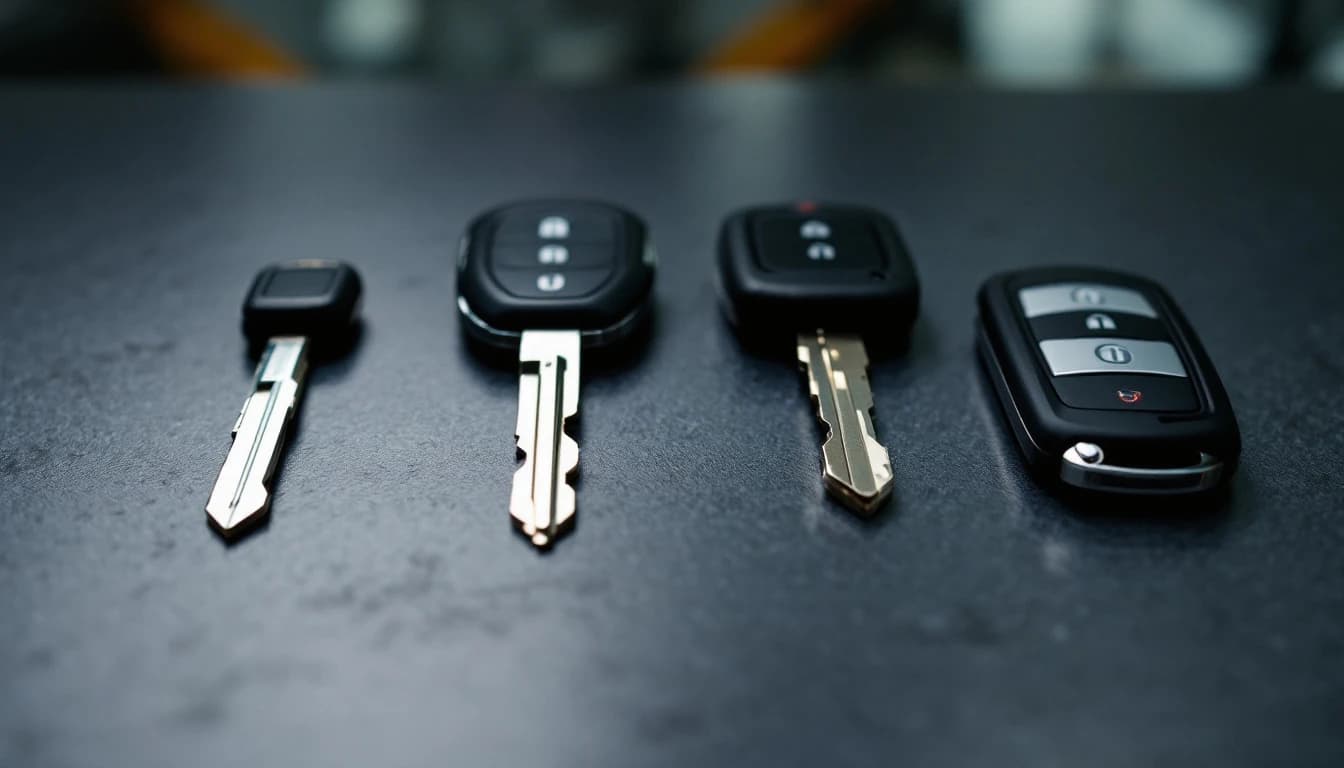
- Look at the key. A blade key with a separate remote, or a flip key with buttons, points at IMMO 3/4. A rectangular proximity fob you never take out of your pocket points at Kessy — IMMO 5 or later.
- Look at the ignition. A mechanical key barrel means an older architecture or a base-trim later car. A start button means Kessy is in the loop.
- Check the build date, not the model year. The sticker in the driver's door jamb or under the boot floor carries the actual production month. Audi platform changes land mid-year, and on a transition-year car the build date is the deciding evidence.
If you are on the phone with us, the VIN settles it in seconds — that is what we are actually asking for when we ask for it.
What each generation costs in DFW
Ranges below reflect mobile pricing in the DFW service area as of August 2026. Final numbers depend on model year, key type and build. Call with your VIN for a firm figure.
| Generation | Spare key | All keys lost | Typical dealer quote |
|---|---|---|---|
| IMMO 3 (1997–2005) | $180–$300 | $300–$550 | $500–$900 |
| IMMO 4 (2005–2010), no Kessy | $200–$350 | $350–$650 | $600–$1,100 |
| IMMO 4 / 5 with Kessy | $250–$450 | $500–$800 | $800–$1,400 |
| MQB (A3 and siblings, 2013–2026) | $250–$450 | $550–$900 | $900–$1,500 |
| MLB / MLB Evo (A4 B9, A6 C8, Q5 FY, Q7 4M, Q8) | $300–$500 | $650–$1,000 | $1,000–$1,800 |
Component protection: what it does and does not affect
This is the single most misunderstood thing about modern Audi work, and it is worth being precise because the internet is not.
Component protection applies to control modules, not to keys. If a control module is replaced — a cluster, a Kessy unit, a BCM2 pulled from a donor car — the vehicle refuses to accept it until it is adapted to that VIN through the manufacturer's online system. That is a genuine constraint, it is deliberate, and no amount of aftermarket tooling makes it go away.
Cutting and programming a key into a car whose modules are all original does not trigger component protection. This is why a spare key on an MQB A3 is a normal appointment while a used-cluster swap on the same car is a dealer conversation.
Where the two meet is all-keys-lost on the newest platforms, when the recovery path involves module work. That is exactly the case where an honest shop asks for your VIN and build date before naming a price, and says "a technician confirms your exact setup" rather than promising an outcome from a make and a model year.
The same architecture and the same constraint apply across the Volkswagen Group. If your car is the Volkswagen sibling rather than the Audi, our Volkswagen key fob troubleshooting guide — including the 2020 Passat covers the symptom side, and VW immobilizer repair in Arlington covers the fix.
What actually happens at the appointment
For a spare key with one working original, on any generation:
- VIN and ownership verification before anything is touched.
- Key cut to code — the emergency blade inside a proximity fob included, which shops frequently skip.
- Diagnostic connection at the OBD-II port, authentication with the working key.
- New transponder written into the vehicle's key list.
- Every function tested: lock, unlock, boot release, start, and the mechanical blade in the driver's door.
Forty minutes is typical. On a Kessy car with several existing fobs, allow an hour.
For all-keys-lost, add: security data recovery from whichever modules hold it on your generation, and on the newest MLB cars, potentially module removal and bench work. Ninety minutes to two and a half hours, depending.
Why the dealer quote is what it is
The gap between $300 mobile and $1,200 at the dealership on the same Audi is mostly structural rather than pure margin.
The blank at list price. An OEM Audi proximity fob carries a substantial dealer markup over trade cost. On a luxury smart key that is $100–$250 of the difference before anyone touches a tool.
Flat-rate labour at the posted shop rate. Dealers bill key programming at the same hourly rate as engine work, in tenth-of-an-hour increments, with a minimum.
The tow you would not otherwise pay for. A car with no working key cannot drive to the service department. That is $150–$300 before work starts, and it is entirely avoidable, because the programming is identical performed in your driveway. The arithmetic is worked through on a real job in our cheapest car key replacement versus the dealership breakdown, and the general Arlington pricing picture is in how much car key replacement costs in Arlington TX.
Scheduling. Audi service departments in the metroplex commonly book key work several days out. Not a line on the invoice, but a real cost if the car is your commute.
Where the dealer genuinely wins: a car inside a factory warranty covering the immobilizer, an open recall touching the security system, or a module replacement that requires an online component-protection adaptation.
If the engine cranks but will not run
An Audi that cranks strongly and refuses to fire, with an immobilizer or key symbol lit in the cluster, is telling you the security handshake failed rather than that the engine has a mechanical problem. Common causes on these platforms are a failed transponder in the key, an antenna ring fault around the ignition barrel, a cluster or ECU that has lost its pairing after a battery event, or a genuinely dead module.
Those are four different repairs at four different prices, and guessing costs money. If the fault followed engine module work rather than key work, our guide on what happens when a car will not start after an ECU swap covers the diagnostic order, and Audi MED17 ECU programming covers the engine-module side.
Frequently Asked Questions
How much is an Audi key replacement in Arlington, TX?
As of August 2026, roughly $200–$450 for a spare key with one working original, and $500–$900 for all-keys-lost, depending on which immobilizer generation your Audi uses. Older IMMO 3 cars sit at the bottom of that range; MLB-platform cars such as the B9 A4, C8 A6, Q7 4M and Q8 sit at the top. Audi dealerships in the metroplex generally quote $800–$1,800 for the same work, plus a tow if the car cannot be driven.
How do I know which Audi immobilizer generation my car has?
Model and year get you most of the way: IMMO 3 runs roughly 1997–2005, IMMO 4 from 2005–2010, IMMO 5 from 2009–2016, and MQB/MLB from 2013 onwards. Then check whether you have a mechanical key barrel or a start button — a start button means the Kessy keyless module is involved. On a transition-year car, the build date on the door-jamb sticker settles it, and the VIN settles it definitively.
Does adding a spare Audi key trigger component protection?
No. Component protection applies to replaced control modules, not to keys. Programming a new key into an Audi whose modules are all original does not invoke it. Component protection becomes relevant when a module is swapped in from another vehicle, or on some newest-platform all-keys-lost recoveries that involve module work.
Can an Audi key be programmed without the car going to the dealer?
For the overwhelming majority of Audis on the road, yes — cutting and programming happen at the vehicle through the OBD-II port, wherever it is parked. The dealer is genuinely required when the vehicle is under a factory warranty covering the immobilizer, when an open recall touches the security system, or when a replaced module needs an online component-protection adaptation.
Why is Audi all-keys-lost so much more expensive than a spare?
With a working key, the immobilizer already trusts a credential and a second one can simply be written into the key list. With no working key, the security data has to be recovered first — from the cluster, the ECU, the Kessy module or the BCM2 depending on generation — and on the newest MLB cars that can mean removing a module and reading it on the bench. The labour multiplies, and so does the risk being carried.
My Audi cranks but will not start and there is a key symbol on the dash. Is my key dead?
Not necessarily. That symbol means the security handshake failed, which can be a dead transponder, a faulty antenna ring around the ignition, a module that lost its pairing after a flat battery or a jump-start, or a failed module. Those are four different repairs. Diagnosis first — replacing a key that was never the problem is the most common wasted spend on these cars.
Are Audi and Volkswagen keys the same job?
Architecturally they are close relatives — both groups share IMMO generations and the MQB platform, and Megamos AES transponders appear across both. In practice Audi trims more often carry Kessy keyless entry and higher-spec modules, which raises the difficulty and the price relative to the equivalent Volkswagen. The diagnostic approach is the same family of work.
Do I need to bring all my existing keys to an Audi key appointment?
Bring them. Audi platforms do not universally erase the key list the way some Japanese systems do, but having every fob present lets the technician verify each one still works after the job and confirm exactly how many credentials the car recognises — which matters on a used car where you cannot be certain how many keys exist.
Book with your VIN in hand
Not Your Basic Locksmith programs Audi keys across the DFW metroplex — Arlington, Fort Worth, Dallas, Grand Prairie, Mansfield, Irving and beyond — at the vehicle, with European electronics as the house specialty since 2012.
Call or text (682) 344-1957 with your VIN, or your year, model and whether you still have a working key. Owner-operated, ALOA Master Automotive Locksmith credentialed, based at 1168 W Pioneer Parkway in Arlington. Texas DPS certificate #B28531501.