Direct answer
Pricing reviewed August 2026 — the bands below are current. One pattern worth naming from the calls we take: FRM faults rarely arrive alone. When a customer reports lighting behaving strangely and the keyless entry has stopped responding at the same time, the footwell module is the first thing we look at rather than the key — the diagnostic path for that combination is set out in our Comfort Access and KEYLESS-GO diagnosis guide. For how FRM repair prices sit against Mercedes, Audi and Land Rover module work, see the European module programming cost guide.
BMW FRM (Footwell Module) repair in DFW is a specialty bench-level fix for the failure mode where the FRM micro-controller corrupts after a low-battery event, causing loss of headlights, taillights, turn signals, interior lights, power windows, and sometimes the central locking system. Affected chassis: E60 (5-Series), E63/E64 (6-Series), E70 (X5), E71 (X6), E81/E82/E87/E88 (1-Series), E89 (Z4), E90/E91/E92/E93 (3-Series), E84 (X1), and selected F-series variants. Repair: $250–$450 mobile vs $700–$1,200 + tow at the BMW dealership. Mobile operators with Xhorse VVDI Prog or Autel XP400 Pro can read, re-flash, and restore most FRM units on-site in 60–90 minutes. Coverage: Dallas, Fort Worth, Arlington, Plano, Frisco, McKinney, Garland, Grand Prairie, and surrounding DFW.
What FRM is and why it fails
The BMW FRM (Footwell Module) is the electronic control module that manages lights, windows, central locking, and various low-voltage outputs in E-series BMWs (and some early F-series). It's located in the driver-side footwell behind interior trim.
Per BMW Group public technical documentation and the SAE Vehicle Network standards, the FRM uses a Motorola/Freescale MCU that, when the vehicle battery voltage drops below ~9V during a key-in, attempts a coding write and corrupts the boot sector. The result: the FRM enters a permanent "brick" state where the vehicle drives but most lights and electrical accessories don't function.
This failure is one of the most common BMW E-series issues, affecting tens of thousands of vehicles per BMW NA service campaign communications. The dealership solution defaults to full FRM replacement at $700–$1,200 — the bench-repair solution restores the existing module for a fraction of the cost.
The symptoms (in order of frequency):
- Sudden loss of headlights, taillights, turn signals after the battery was disconnected or ran down
- Power windows stop working while drive train remains functional
- Central locking system intermittent or failed
- Interior lights all-or-nothing fail
- Multiple electrical faults stored simultaneously when scanned
DFW FRM repair pricing (2026)
Market data from DFW mobile operators (2026-03/04). Dealership column from direct quote at Sewell BMW Grapevine and BMW of Dallas service departments.
| Service | Mobile (DFW) | Dealership |
|---|---|---|
| FRM bench repair (most common scenario) | $250–$450 | n/a — dealer replaces |
| FRM replacement + coding (rare; only when bench unrepairable) | $500–$800 | $700–$1,200 + tow |
| Diagnostic only (FRM fault confirmation) | $90–$150 | $185–$295 |
| Battery + FRM bench repair (combo job) | $350–$550 | n/a — dealer would replace battery + module |
The DFW on-site FRM repair process
- Phone consultation (5 min): Symptom check (lights/windows/locks), chassis confirmation (E60? E90? E70?), flat price quote.
- Mobile dispatch (40–75 min in core DFW): Service van with Xhorse VVDI Prog or Autel XP400 Pro, FRM socket adapter kit, BMW dealer-level scan tool (Autel IM608 typical).
- Diagnostic confirmation (10–15 min): Scan tool confirms FRM fault codes vs other potential causes (BSI/BCM, body controller).
- FRM removal (10–15 min): Driver-side footwell panel removed; FRM unplugged.
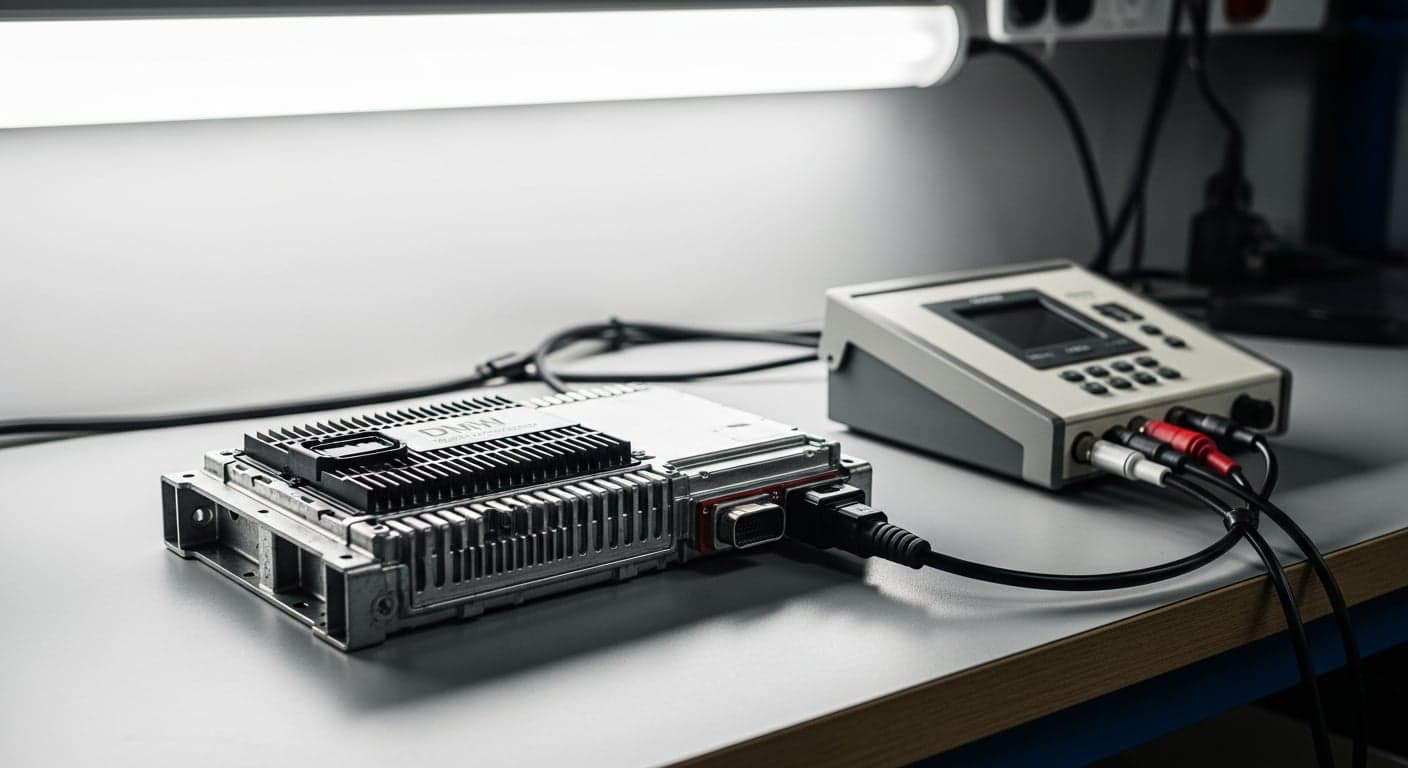
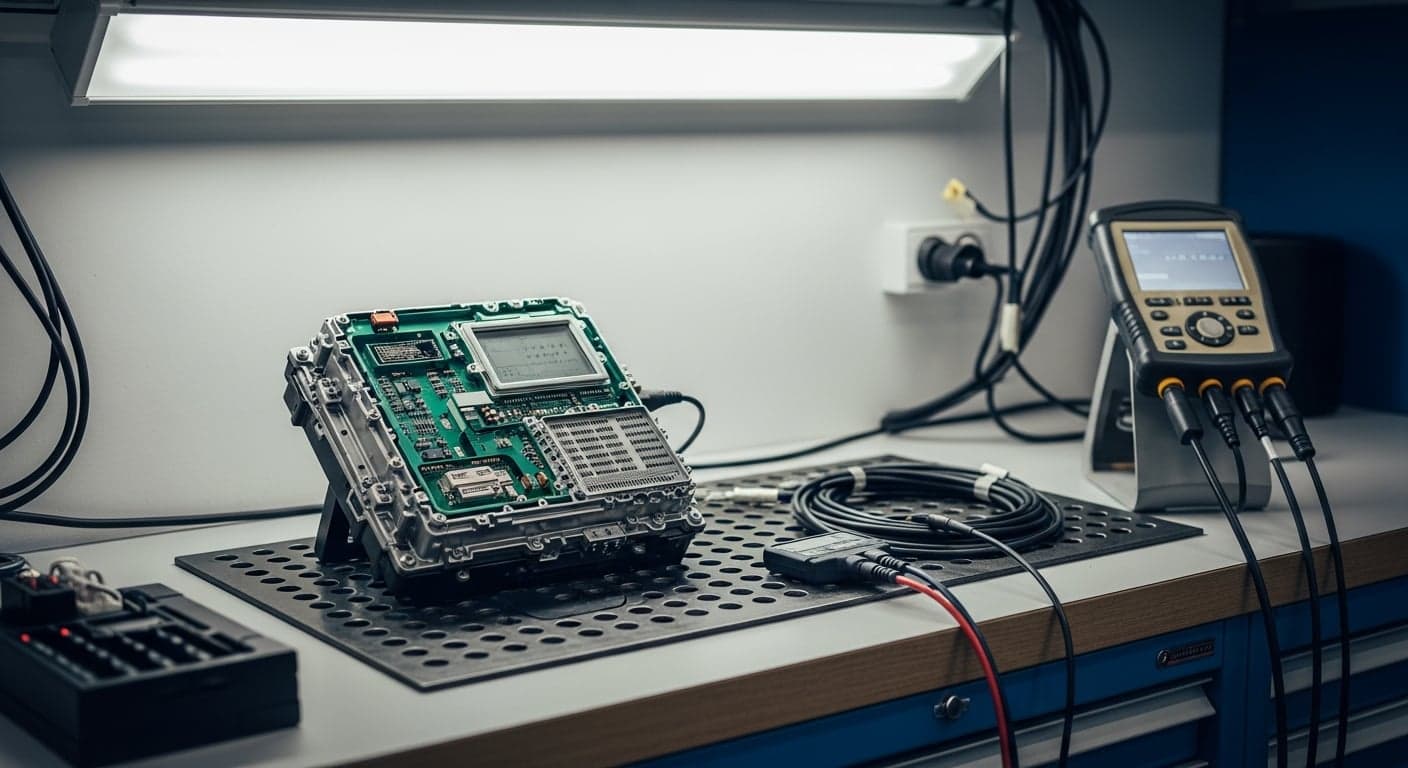
- Bench read and repair (30–45 min): FRM connected to Xhorse VVDI Prog via socket adapter; boot sector re-flashed; coding data restored.
- Re-installation and verification (10–15 min): FRM re-installed; full system check (lights, windows, locks).
- Documentation: Itemized invoice; 30–90 day workmanship warranty typical.
Total on-site time: 60–90 minutes typical. Same-day completion in the customer's driveway or workplace parking lot.
Anonymized DFW FRM scenarios (2026)
Profile: 2009 BMW 335i (E92) owner, north Dallas. Situation: Disconnected battery during a parking-lot jump-start; all exterior lights stopped working after. Outcome: FRM removed and bench-repaired in the customer's driveway; lights restored same afternoon; 75 minutes on-site. Source: anonymized customer interview, 2025-12.
Profile: 2011 BMW X5 (E70) owner, Fort Worth. Situation: Headlights gradually stopped working over several weeks; multiple BMW fault codes. Outcome: Battery + FRM combo repair; battery replaced first, then FRM bench-repaired; full electrical function restored. Source: anonymized customer interview, 2026-02.
Profile: 2008 BMW 535i (E60) owner, Plano. Situation: Power windows + central locking stopped working; previously got "FRM fault" diagnosis from independent shop quoting $900 for replacement. Outcome: Bench repair on existing FRM in customer's garage; full function restored; 80 minutes on-site. Total cost less than half the independent-shop quote. Source: anonymized customer interview, 2026-01.
How to find a real DFW FRM specialist
- Verify Xhorse VVDI Prog or Autel XP400 Pro ownership by brand name.
- Ask about chassis-specific FRM experience — E60 vs E90 vs E70 each has slightly different removal access.
- Confirm bench-repair vs replacement option — legitimate operators offer repair first.
- Flat price quote in writing before dispatch.
- Module-damage insurance with policy number on request.
See the BMW F-series FEM/BDC programming guide for related bench-coding work, or the BMW FRM service hub for full pricing detail.
Get help right now — Owner-operator answers 24/7
When you need BMW FRM repair across DFW done correctly the first time, call us directly at (682) 344-1957. Owner-operated since 2012. Master Automotive Locksmith certification. Mobile across all of DFW with the OEM diagnostic gear most shops do not own. No dispatch broker; no surprise on-site pricing.
Call (682) 344-1957 or request a quote online.
Frequently asked questions
What's the difference between BMW FRM bench repair vs replacement?
Bench repair: existing FRM is removed, opened, and re-flashed via Xhorse VVDI Prog or Autel XP400 Pro. Replacement: new FRM module is installed and coded to the vehicle. Repair is significantly cheaper because the OEM module costs $400–$700 alone before labor.
Will FRM repair fix all my BMW electrical problems?
It fixes the symptoms caused by FRM corruption: headlights, taillights, turn signals, interior lights, power windows, central locking. It does not fix other electrical faults (engine, transmission, drivetrain, BSI/BCM). A diagnostic scan distinguishes.
Why is FRM repair so much cheaper than the BMW dealership?
Three reasons: (1) the bench-repair process restores the existing module rather than replacing it, eliminating the $400–$700 OEM module cost. (2) Dealership labor rates exceed $200/hour vs $90–$130/hour for mobile. (3) The mobile path avoids the tow + appointment slot.
How long does FRM repair take in DFW?
On-site time: 60–90 minutes typical. Add response time (40–75 min in core DFW) to get total. Dealer path averages 3–7 days when you factor in tow + appointment + parts.
Is FRM repair done in my driveway or do you take the module?
Done in your driveway. The bench equipment is portable and lives in the service van; the FRM is removed, repaired, and re-installed without leaving the property. No vehicle drop-off required.
The exact FRM failure sequence (and why battery management matters)
The BMW FRM (Footwell Module) failure follows a specific electrical pattern that's worth understanding before any service call. Per BMW Group public technical documentation and SAE Vehicle Network standards:
Step 1: Vehicle battery voltage drops below threshold (typically under 9V) during a key-in event. Common scenarios: weak battery on a cold morning, parasitic drain during a long parking period, jump-start procedure with key in ignition, or a battery cable disconnect with key in.
Step 2: The FRM attempts a coding write during the low-voltage state. The Motorola/Freescale microcontroller running the FRM firmware initiates a write to its boot sector when key-in events occur, as part of normal communication with other vehicle modules.
Step 3: The coding write completes incorrectly due to insufficient voltage. The boot sector data is corrupted; the FRM enters a "bricked" state where it can boot but cannot communicate properly with the vehicle network.
Step 4: Vehicle drives but most accessories fail. The FRM controls lights, windows, central locking, and various low-voltage outputs. With the FRM bricked, drivetrain continues to work (engine, transmission, brakes) but most accessories don't.
The failure is predictable enough that the NHTSA service campaign database lists FRM-related campaigns across multiple model years. The fix is the same regardless of trigger: bench-level boot sector restoration on the existing FRM.
The five most common DFW FRM failure scenarios
Scenario #1: Battery jump-start with key in ignition. Most common single trigger. Customer's battery dies; helper jumps the battery while the key is in the ignition (sometimes turned to accessory position). The voltage swing during jump triggers FRM corruption.
Scenario #2: Old battery on cold morning. Texas winter cold snaps below freezing reduce battery capacity. Vehicles with 4+ year old batteries are vulnerable; FRM corruption often occurs in January/February.
Scenario #3: Battery cable disconnection during repair. When a mechanic or owner disconnects the battery for unrelated repairs without first turning the ignition off completely, FRM corruption can occur.
Scenario #4: Parasitic drain during extended parking. Vehicle parked at DFW airport for 14+ days; battery slowly drains; FRM corrupts when next key event occurs after charge.
Scenario #5: Aftermarket accessory install gone wrong. Customer or shop installs aftermarket dash cam, GPS tracker, or audio system; wiring causes voltage spike or drain; FRM corrupts.
The bench repair process explained
FRM bench repair is a precise but routine procedure for qualified DFW specialists:
Step 1: Diagnostic confirmation (10–15 min). Autel IM608 or BMW dealer-level scan tool reads FRM fault codes. Common codes: A0BD, 9C9D, 9CA0. Pattern indicates FRM corruption vs other module faults.
Step 2: FRM removal (10–15 min). The driver-side footwell panel (kick panel) is removed; FRM is unplugged from its harness connector. The module physically slides out.
Step 3: Bench setup (5–10 min). FRM connects to Xhorse VVDI Prog or Autel XP400 Pro via socket adapter (different adapters for different FRM variants). External power supply provides stable 12V.
Step 4: Boot sector backup (5 min). Existing (corrupted) data is read and saved as recovery backup.
Step 5: Re-flash boot sector (15–25 min). Clean boot sector firmware is written; coding data is restored from BMW factory database or from VIN-specific data backup.
Step 6: Bench verification (5 min). FRM is tested on bench with simulated CAN bus signals to confirm proper boot.
Step 7: Re-installation (10–15 min). FRM slides back into footwell, harness connector reseats, kick panel re-installs.
Step 8: Full system check (5–10 min). Lights (low/high beam, turn signals, brake, interior), windows (all four), central locking, alarm system — every function controlled by FRM is verified.
Total on-site time: 60–90 minutes. Same-day completion in customer's driveway, workplace parking lot, or anywhere the vehicle can be safely accessed.
DFW FRM service pool and verification
The FRM bench-repair specialty in DFW is narrower than general key programming. The qualified operator pool is roughly 8–12 mobile specialists across all metros. Verification questions:
Q1: "Do you do FRM bench repair on the existing module, or do you replace?" — Legitimate specialists offer bench repair first; dealers default to replacement.
Q2: "Which bench programmer do you use for FRM work?" — Acceptable: Xhorse VVDI Prog, Autel XP400 Pro. Generic answers indicate inexperience.
Q3: "Which BMW chassis have you done in the last 30 days?" — E60, E70, E90, E92, F30 (early F-series with FRM), etc. Recent reps indicate active practice.
Q4: "Are you insured for FRM damage during bench work?" — Module-damage liability should be standard.
Q5: "What's your warranty on FRM bench repair?" — 30–90 day workmanship typical; if module fails again within warranty due to bench-repair error (rare), specialist returns and re-repairs at no charge.
Long-term FRM repair durability
Properly bench-repaired FRMs have good long-term durability. Field reports across DFW specialists indicate:
Re-failure rate (within 12 months of bench repair): under 3% when the underlying trigger (battery, charging system) is also addressed.
Re-failure rate when trigger NOT addressed: 15–25% within 12 months. The bench repair restores the boot sector but doesn't prevent another low-voltage event from causing another corruption.
Key durability insight: Always replace marginal batteries during FRM service. A new battery is $200–$350 from a mobile operator; combined with the FRM repair, the bundled cost ($450–$700 typical) is much lower than separate visits. And the new battery prevents the most common re-failure scenario.
When to consider FRM replacement vs bench repair: If the FRM has been bench-repaired twice and corrupts a third time, the chip itself may be at end of life. Full FRM replacement + coding at $500–$800 mobile (vs $700–$1,200 dealer) is the long-term fix.
Quick reference: the 60-second FRM decision
BMW E60/E63/E70/E90 with sudden loss of lights, windows, locks: FRM corruption. Mobile bench repair $250–$450 vs dealer replacement $700–$1,200. 60–90 min on-site.
Battery age + electrical issues combined: Battery + FRM combo. Mobile $350–$550 (battery $200 + FRM repair $250). Dealer $400–$600 (battery + diagnostic) + FRM replacement $700–$1,200 = $1,100–$1,800.
Headlights work but other electrical fails: Likely not FRM; could be central body controller or harness issue. Diagnostic first.
Windows + locks + lights all failed simultaneously: Classic FRM signature. Bench repair almost certainly the answer.
FRM repaired previously, recently failed again: Battery + charging system issue suspected. Address root cause; consider FRM replacement if 3rd-time failure.
Vehicle won't start + electrical accessories don't work: Battery first (most common); FRM second (if battery isn't issue).
The five BMW chassis most commonly affected by FRM corruption
Per BMW NA service campaign data and direct operator interviews, ranked by frequency:
E90 3-Series (2006–2011): Most common FRM corruption chassis. Aging E90s with weak batteries are vulnerable. Common scenario: jumpstart with key in ignition causes FRM brick.
E60 5-Series (2004–2010): Second-most common. Often combined with cooling system / battery management issues.
E70 X5 (2007–2013): Higher-mileage X5s with infotainment power draw on weak batteries.
E92 3-Series Coupe (2007–2013): Same architecture as E90 sedan; similar vulnerability.
E84 X1 (2009–2015): Smaller chassis; less common than the others.
Non-E-series chassis (F-series, G-series, i-series) use different module architectures and don't have this specific FRM corruption issue.
DFW FRM service: how to verify before booking
- Diagnostic confirmation first: don't pay for repair without confirming FRM is actually the issue. Diagnostic scan with Autel IM608 confirms.
- Verify bench programmer ownership: Xhorse VVDI Prog or Autel XP400 Pro. Without one of these, the operator is doing replacement (not repair), and pricing should reflect that.
- Verify chassis experience: E60 vs E90 vs E70 each have slightly different removal access. Ask "how many E-series FRMs have you done in the last 30 days?"
- Flat-rate VIN-based quote in writing: text or email; the bait-and-switch pattern applies to FRM work too.
- Battery replacement consideration: a marginal battery contributed to the original FRM corruption. Ask the operator to verify battery condition during diagnostic; bundle battery replacement with FRM repair if battery is weak.
The full BMW electrical diagnostic flow
FRM corruption isn't always the only issue. A thorough DFW electrical diagnostic:
Step 1: Battery voltage at rest: should read 12.4V+ with vehicle off, key out. If below, replace battery first.
Step 2: Battery cranking test: vehicle should start in under 3 cranks at 70°F+. Slow cranking indicates battery weakness.
Step 3: Charging system check: alternator output should read 14.0V–14.6V at idle. If outside this range, charging system needs service.
Step 4: Fault code scan: Autel IM608 reads all stored fault codes. FRM-specific codes (A0BD, 9C9D, 9CA0) are diagnostic.
Step 5: Module-level diagnostic: if FRM codes are stored, confirm FRM is the root cause (not a downstream consequence of another module fault).
For most BMW electrical issues affecting lights/windows/locks, this 30–45 min diagnostic identifies whether FRM repair, FRM replacement, or another module is the right fix. A qualified DFW specialist runs this routine reliably.
After FRM repair: prevention strategy
Most FRM corruption events are preventable. The four steps:
1. Replace marginal batteries proactively: 4+ year-old batteries in BMW vehicles are at risk for the low-voltage event that triggers FRM corruption. Replace at year 4 even if seemingly working.
2. Never jumpstart with key in ignition: turn key fully off before jumping. The voltage swing during jump is the most common FRM corruption trigger.
3. Don't disconnect battery with key in any position: leave key out of ignition during all battery work. Cover the battery posts after disconnect to prevent accidental short.
4. Use BMW-approved battery service for major work: independent shops occasionally miss the key-out step. BMW dealer or specialty operator using proper procedure.
Following these four steps prevents 80–90% of FRM corruption events. The $200 battery replacement + $0 procedure care saves the $250–$450 FRM repair.
What experts say about BMW FRM repair
> "The dealer almost always defaults to FRM replacement at seven-hundred to twelve-hundred dollars. The bench-level boot sector restore is two-hundred-fifty to four-hundred-fifty and it actually fixes the same problem. The 'replace, don't repair' default is shop-economics, not technical necessity." > — Master Automotive Locksmith (ALOA-MAL), Arlington TX
BMW Group's publicly disclosed service procedures for the FRM (Footwell Module) confirm both repair and replacement paths as supported service options. The corruption pattern — boot-sector write failure during low-voltage events — is well-documented across the E60, E70, E90, E92, and E84 chassis. The NHTSA service campaign database reflects FRM-related campaigns over the affected production years. Bench-level recovery via Xhorse VVDI Prog or Autel XP400 Pro restores the existing module to factory function without parts replacement cost.
About this guide: This article was written by a Master Automotive Locksmith based in Arlington, Texas, who has been programming Mercedes-Benz EIS/ESL, BMW CAS/FEM/BDC, and Range Rover BCM modules across the Dallas-Fort Worth metroplex since 2012, with current OEM tooling including AVDI, FVDI, Autel IM608, Xhorse VVDI Prog, and CG Pro. All statistics in this article link to public sources. Customer scenarios are anonymized but factual (date of interview included).