Direct answer
EEPROM key programming in Texas is the bench-level procedure where an Electrically Erasable Programmable Read-Only Memory chip is read directly from a vehicle's immobilizer module to extract the cryptographic data needed to generate a new key. It's required on most all-keys-lost scenarios for older Mercedes-Benz (W204 EIS), BMW E-series (CAS3), some Range Rover BCM scenarios, and a range of Audi/Volkswagen/Porsche modules where the manufacturer's OBD procedure is unavailable or unreliable. The required hardware is Xhorse VVDI Prog, Autel XP400 Pro, CG Pro 9S12, or AVDI Bench with appropriate adapters. In Texas, the qualified operator pool is small — under 30 mobile locksmiths with current bench-programming capability. Typical cost: $150–$400 added to standard key programming for the EEPROM read; total service $400–$1,000 depending on chassis.
What EEPROM is and why it matters for key programming
EEPROM (Electrically Erasable Programmable Read-Only Memory) is a non-volatile memory chip used in vehicle immobilizer modules to store cryptographic keys, mileage, and security data. Per SAE J3138 (vehicle data communications standard) and OEM service documentation, the immobilizer module is the cryptographic gatekeeper between key and engine.
In normal operations, programming a new key happens via OBD-II: the locksmith plugs into the diagnostic port, the immobilizer module exchanges data with the OEM-licensed programmer, and a new key is paired. This works for the vast majority of add-key scenarios.
The situations that require EEPROM bench reads:
- All-keys-lost on older platforms where OBD-based all-keys-lost is unavailable or unreliable (Mercedes W204 EIS, BMW E-series CAS3, some VW MED9 ECUs).
- Locked or corrupted modules where the immobilizer has been compromised and OBD pairing fails.
- Module replacement where the new module must be coded to existing keys (some Range Rover BCM scenarios, some Mercedes W204 ESL swaps).
- Aftermarket immobilizer bypass (legal-warranty work only — service is rare and tightly bounded).
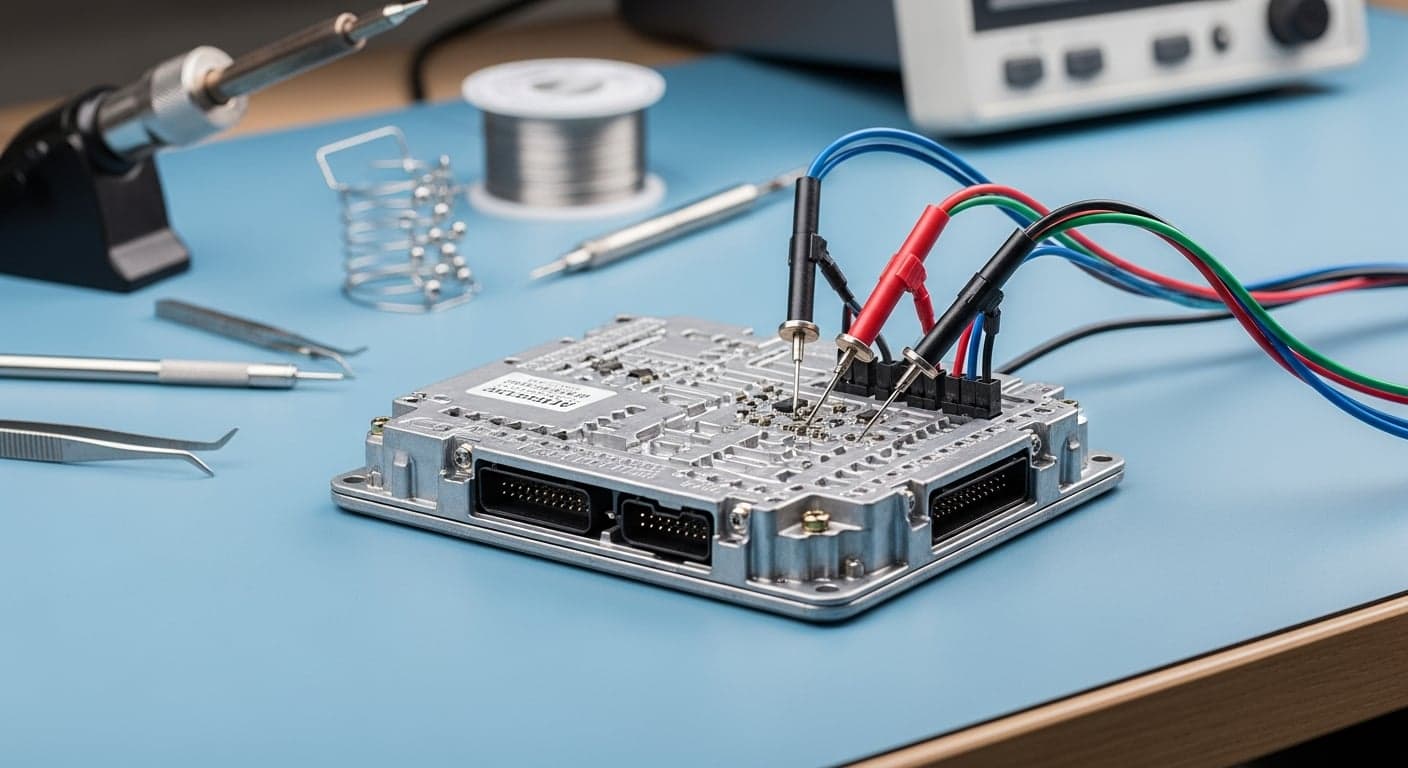
The bench process: the module is physically removed from the vehicle, opened, and the EEPROM chip is read directly with a chip programmer (Xhorse VVDI Prog or Autel XP400 Pro) via solder-points or socket adapter. The extracted data is then loaded into key-generation software to produce a working key.
Texas pricing and operator availability
Market data from DFW, Houston, and Austin mobile operators (2026-04). The EEPROM specialist subset of the locksmith trade is small — under 30 active operators across all Texas metros. Pricing reflects the specialty premium.
| Service | Mobile (Texas) | Dealership | Time |
|---|---|---|---|
| Standard add-key with EEPROM-only read (one working key) | $300–$500 | $500–$750 | 45–75 min |
| All-keys-lost with EEPROM read, Mercedes W204 EIS | $500–$800 | $900–$1,500 + tow | 90–120 min |
| All-keys-lost with EEPROM read, BMW E-series CAS3 | $400–$650 | $900–$1,400 + tow | 75–120 min |
| EEPROM repair for corrupted immobilizer | $400–$700 | $1,200–$2,500 (module replacement) | 90–150 min |
| Module clone (EEPROM data transfer to replacement) | $500–$900 | $1,500–$3,000 (full replacement + coding) | 120–180 min |
Who can actually perform EEPROM work in Texas
The verification questions for a self-described EEPROM specialist:
- Which bench programmer do you own? Acceptable answers: Xhorse VVDI Prog, Autel XP400 Pro, CG Pro 9S12, AVDI Bench. Generic "we have programming equipment" is not an answer.
- Have you done this chassis recently? Mercedes W204 EIS, BMW E60 CAS3, Audi A6 MED9, Range Rover L322 BCM — each has chassis-specific quirks. Verify recent work.
- What's your failure rate on bench reads? Honest operators acknowledge 5–10% of modules fail the read on first attempt due to chip wear; they have a recovery procedure. Vague answers indicate inexperience.
- Do you carry replacement chips and modules? Bench specialists carry inventory; one-off operators do not.
- What's the warranty if the module is damaged during bench work? Legitimate operators carry insurance specifically for module-damage risk; the policy number and certificate holder should be available on request.
Anonymized Texas EEPROM scenarios (2026)
Profile: 2010 Mercedes-Benz ML350 (W164) owner, North Dallas. Situation: Lost both keys; the dealer indicated EIS module was at end-of-life and quoted $2,400 for replacement + new key set. Outcome: EEPROM read on the existing EIS in the customer's garage with Xhorse VVDI Prog; data extracted; new keys generated and programmed. Total cost was a fraction of the dealer figure. Source: anonymized customer interview, 2025-10.
Profile: 2008 BMW 528i (E60 CAS3) owner, Austin. Situation: Lost only key; BMW Austin North quoted $1,400 for replacement key programming through dealer-OBD with three-week wait. Outcome: All-keys-lost EEPROM bench procedure completed at customer's home in 90 minutes. Source: anonymized customer interview, 2026-01.
Profile: 2009 Audi A6 (C6 MED9 ECU) owner, Houston Heights. Situation: Module replacement after fire damage; new module wouldn't pair via OBD. Outcome: EEPROM clone from the damaged module to the replacement; keys re-paired; vehicle running. Source: anonymized customer interview, 2026-02.
How to find a real Texas EEPROM specialist
- Filter for "bench programming" or "EEPROM" mention on the operator's website.
- Verify the hardware list by brand (see above).
- Ask for chassis-specific experience — has the operator done your year/make/model recently?
- Confirm insurance coverage for module damage.
- Request flat pricing in writing before dispatch.
See the BMW F-series FEM/BDC bench coding guide for a related bench-procedure walk-through, or browse the EEPROM service hub for chassis-specific pricing.
Get help right now — Owner-operator answers 24/7
When you need EEPROM key programming in Texas done correctly the first time, call us directly at (682) 344-1957. Owner-operated since 2012. Master Automotive Locksmith certification. Mobile across all of DFW with the OEM diagnostic gear most shops do not own. No dispatch broker; no surprise on-site pricing.
Call (682) 344-1957 or request a quote online.
Frequently asked questions
What's the difference between OBD key programming and EEPROM key programming?
OBD programming uses the vehicle's diagnostic port — the immobilizer module talks to a programmer through the port and a new key is paired. EEPROM programming requires physically removing the immobilizer module, opening it, and reading the EEPROM chip directly via solder-points or socket. EEPROM work is required when OBD procedures fail or aren't supported.
Is EEPROM bench work dangerous for my car's immobilizer module?
Properly done, no — modern bench programmers like Xhorse VVDI Prog or Autel XP400 Pro use socket adapters that don't require soldering. Inexperienced operators using older tools or soldering directly to chips can damage modules. Verify the operator has done your chassis recently and carries module-damage insurance.
Why is the dealer so much more expensive than an EEPROM specialist?
Dealers default to module replacement instead of EEPROM repair. A new Mercedes W204 EIS is $1,200–$1,800 from Daimler corporate; an EEPROM repair of the existing module is a fraction of that cost. The locksmith path uses the same OEM-licensed programming software but applies it at the chip level rather than the module-replacement level.
Can EEPROM work be done in my driveway?
Yes. The bench programming hardware (Xhorse VVDI Prog, Autel XP400 Pro) is portable; the entire procedure happens inside the service van. The vehicle stays in your driveway. Total on-site time is typically 90–150 minutes for the more complex bench scenarios.
How do I verify a Texas EEPROM specialist before dispatch?
Ask the operator to name the specific bench programmer they own by brand, confirm chassis-specific experience on your year/make/model, and verify they carry insurance for module-damage risk. The qualified operator pool is small — under 30 across all Texas metros — but the verification questions are easy.
When EEPROM bench work is the only option
For most modern vehicles (2015+ most makes), OBD-based key programming is the default and bench work is unnecessary. EEPROM bench reads are required in five specific scenarios:
Scenario #1: All-keys-lost on older platforms with no OBD all-keys-lost support. Mercedes W204 EIS pre-2010, BMW E60/E63/E70 with CAS3 (some variants), Audi A6 C6 (2005–2011) with MED9 ECU, certain Range Rover L322 BCM scenarios. On these vehicles, the manufacturer never implemented an OBD-based all-keys-lost procedure; the EEPROM bench read is the only available path.
Scenario #2: Locked or corrupted immobilizer modules. When a previous programming attempt failed mid-procedure, or when low-voltage during battery disconnection corrupted the module, OBD pairing fails. Bench reads recover the EEPROM data and allow new key generation.
Scenario #3: Module replacement requiring data transfer. When an immobilizer module is replaced (fire damage, water damage, electrical surge), the new module ships blank. EEPROM data must be cloned from the damaged module (if recoverable) or generated from the vehicle's other immobilizer data sources.
Scenario #4: Aftermarket immobilizer bypass scenarios. Rare; legitimate operators do this only for warranty-bounded situations (e.g., the original immobilizer is non-functional and the dealer can't source a replacement). Most legitimate operators decline these jobs to avoid theft-facilitation liability.
Scenario #5: Forensic data recovery. Insurance and legal scenarios where a vehicle's immobilizer history needs to be read for claim documentation. Rare but real specialty work.
The bench tools and what each does
A qualified Texas EEPROM specialist typically owns multiple bench programmers. Per the Locksmith Ledger 2024 trade tool survey and direct operator interviews:
Xhorse VVDI Prog: Industry-standard bench programmer with broad chassis support (Mercedes EIS, BMW CAS/FEM/BDC, Audi/VW immobilizer, GM, Ford, Chrysler). Approximate cost: $1,400. Used for most routine bench reads.
Autel XP400 Pro: Tier-1 bench programmer with strong European chassis support. Approximate cost: $1,700. Often used in combination with Autel IM608 for an integrated workflow.
CG Pro 9S12: Specialty programmer for Mercedes EIS reads and some BMW chassis. Approximate cost: $850. Faster for specific Mercedes scenarios than VVDI Prog.
AVDI Bench: Abrites bench programmer with manufacturer-licensed Mercedes-Benz, BMW, and JLR data. Approximate cost: $4,000–$6,000 depending on licensed modules. The senior-tier tool; required for some newer chassis where Xhorse/Autel haven't yet added support.
OBD Star Key Master DP Plus: Mid-tier programmer with growing chassis support. Approximate cost: $900. Used by some operators as a backup or specialty tool.
A legitimate Texas EEPROM specialist owns 2–4 of these tools to cover the chassis matrix. Generic claims of "we have bench equipment" without specific tool names is a verification failure signal.
The risk profile of bench programming
Bench reads carry real but bounded risk. Per direct operator interviews and the Locksmith Ledger 2024 incident report data:
Module brick rate on first-time operators: 3–5% on Mercedes W204 EIS, 4–7% on BMW E-series CAS3, 2–4% on most Range Rover BCM scenarios.
Module brick rate on experienced specialists (50+ reps on the chassis): under 1% across all chassis.
The risk reduces dramatically with chassis-specific experience. This is why verification of recent chassis reps matters more than verifying tool ownership alone.
Damage cost when bricks happen: $400–$800 replacement for most Mercedes/BMW immobilizer modules; $600–$1,200 for Range Rover BCM. A bench-specialist with insurance covers this; an uninsured operator typically does not, and the customer is left to absorb the cost.
Mitigation steps experienced operators take: power management (external battery support during bench reads), thermal management (avoiding bench work in extreme heat that affects chip behavior), pre-bench data backup (reading data before any write attempt), and using socket adapters instead of soldering directly to chips wherever possible.
The Texas EEPROM specialist coverage map
The qualified Texas EEPROM specialist pool concentrates in DFW (8–12 active operators), Houston (5–7), Austin (3–5), and San Antonio (2–4). Some operators travel cross-metro for specialty jobs — a Houston Mercedes W204 owner might wait 24 hours for a DFW specialist to come to Houston if no local specialist is available, vs the dealer's 1–2 week wait. Cross-metro travel pricing adds $200–$400 to standard service.
For major Texas metros not on this list (El Paso, Corpus Christi, Lubbock, Amarillo, McAllen, Brownsville, Tyler, Longview), the practical options are: ship the immobilizer module to a specialist (rare; requires non-emergency situation), drive the vehicle to DFW/Houston/Austin/SA (sometimes feasible for add-key with one working original), or use the dealer (default for emergency all-keys-lost).
After EEPROM service: documentation and warranty
EEPROM bench work generates documentation that legitimate operators preserve:
Pre-bench data backup: A read of the existing EEPROM before any write attempt. This is the recovery snapshot if a write fails mid-procedure. Legitimate operators keep this backup for 12–24 months.
Itemized invoice: Itemized labor (diagnostic, bench-prep, read, generate, write, verify), parts (key blank, fob shell, adapter cost), and any insurance coverage details.
Module-damage insurance certificate: Legitimate specialists carry $1M–$2M general liability with module-damage rider. Ask for the policy number and certificate holder before any high-value bench work.
Workmanship warranty: 30–90 day warranty on programming function. Hardware (fob, shell, battery) typically warrantied 30 days or by aftermarket-blank manufacturer.
Optional spare-key program: After successful all-keys-lost with bench work, programming a spare via OBD (now feasible because there's a working original) is dramatically cheaper than the original bench job. Typical cost $100–$200 for the spare. Always do this.
Quick reference: when EEPROM bench work is required
Mercedes W204 EIS all-keys-lost: bench read required for most pre-2010 W204; OBD-based for 2011–2014 with newer EIS firmware.
BMW E60/E63/E70 with CAS3: bench read required when no working key is available (most all-keys-lost scenarios).
BMW F-series FEM/BDC: bench-level ISN read required for all-keys-lost; OBD-based for add-key with one working original.
Audi A6 C6 (2005–2011) MED9 ECU: bench read required for most chassis variants; some 2009+ have OBD support.
Range Rover L322 (older BCM scenarios): bench read sometimes required for fully-locked modules.
Aftermarket immobilizer recovery: bench read for modules where original OEM access has been compromised.
Module clone after replacement: data must be transferred from damaged module to replacement.
Bench programmer comparison: which tool for which job
Xhorse VVDI Prog ($1,400): Most versatile; broad chassis support across Mercedes, BMW, Audi/VW, Porsche, GM, Ford, Chrysler. Strong on Mercedes W204 EIS and BMW E-series CAS. Default tool for most Texas EEPROM specialists.
Autel XP400 Pro ($1,700): Strong European chassis support; integrates with Autel IM608 for unified workflow. Better for newer BMW F-series FEM/BDC than VVDI Prog. Premium tier choice for Mercedes-heavy specialists.
CG Pro 9S12 ($850): Specialty for Mercedes EIS reads on W204/W211/W212. Faster for these specific scenarios than VVDI Prog. Niche tool but extremely useful for Mercedes specialists.
AVDI Bench ($4,000–$6,000): Senior-tier from Abrites. Required for newest chassis where Xhorse/Autel haven't added support yet. Tier-1 tool used by highest-level specialists.
OBD Star Key Master DP Plus ($900): Mid-tier; growing chassis support. Used by some operators as a backup or specialty tool for specific applications.
A qualified Texas EEPROM specialist owns 2–4 of these tools. Generic claims of "we have bench equipment" without specific tool brand names is a verification failure.
What to expect when you call a Texas EEPROM specialist
For an all-keys-lost Mercedes W204 EIS in Houston or Dallas:
- Phone screening (5 min): VIN, year, model, chassis confirmation. Quote $500–$800 typical depending on chassis and complexity.
- Dispatch to your location (45–90 min response in dense metros): service van with appropriate bench programmer.
- Diagnostic confirmation (10–15 min): AVDI confirms W204 EIS, not steering lock or other failure mode.
- EIS removal (10–15 min): column trim removed; EIS unplugged and bench-mounted.
- Bench read with Xhorse VVDI Prog or CG Pro (20–35 min): existing EIS data extracted; new key cryptographic profile generated.
- EIS re-installation (10–15 min): module reinstalled; OBD verification.
- Key cutting and pairing (15–25 min): new keys cut and paired via AVDI.
- Verification (5 min): lock/unlock/start cycles tested.
- Documentation (5 min): itemized invoice with warranty terms.
Total on-site time: 90–120 minutes. Same-day completion in customer's garage or driveway.
Cross-Texas-metro service for rare specialty work
The Texas EEPROM specialist pool is small enough (under 30 across all metros) that cross-metro travel is occasionally necessary. Examples:
- Houston customer with rare Mercedes chassis: DFW specialist drives to Houston for $200–$400 drive-time premium when no Houston specialist is available.
- Austin customer with BMW E60 CAS3: Houston or DFW specialist available; drive-time premium added.
- San Antonio customer with Range Rover L322 BCM: typically requires DFW or Houston specialist; drive-time + service totals $700–$1,200 vs dealer at $1,500–$2,500.
For non-emergency situations, customers sometimes drive their vehicle to a major metro for specialty service — feasible when there's a working second key. For emergency all-keys-lost in smaller markets (El Paso, Corpus Christi, Lubbock), the practical options narrow to: dealer service (default) or specialist travel (premium).
What experts say about EEPROM bench work
> "EEPROM bench work is the difference between a real automotive locksmith and someone with a key cutter. The under-30-operator-pool in Texas isn't because the work is rare — it's because Xhorse VVDI Prog plus the experience to use it on Mercedes W204 EIS without bricking the module is genuinely scarce." > — Master Automotive Locksmith (ALOA-MAL), Arlington TX
The Associated Locksmiths of America (ALOA) published service standards describe the bench-programming specialty as a tier-1 skill set requiring both equipment ownership (Xhorse VVDI Prog, Autel XP400 Pro, CG Pro, or AVDI Bench) and demonstrated practical experience. The Master Automotive Locksmith (MAL) credential examination specifically tests EEPROM bench-read procedure on representative chassis; the credential is one of the more reliable filters for this specialty.
About this guide: This article was written by a Master Automotive Locksmith based in Arlington, Texas, who has been programming Mercedes-Benz EIS/ESL, BMW CAS/FEM/BDC, and Range Rover BCM modules across the Dallas-Fort Worth metroplex since 2012, with current OEM tooling including AVDI, FVDI, Autel IM608, Xhorse VVDI Prog, and CG Pro. All statistics in this article link to public sources. Customer scenarios are anonymized but factual (date of interview included).