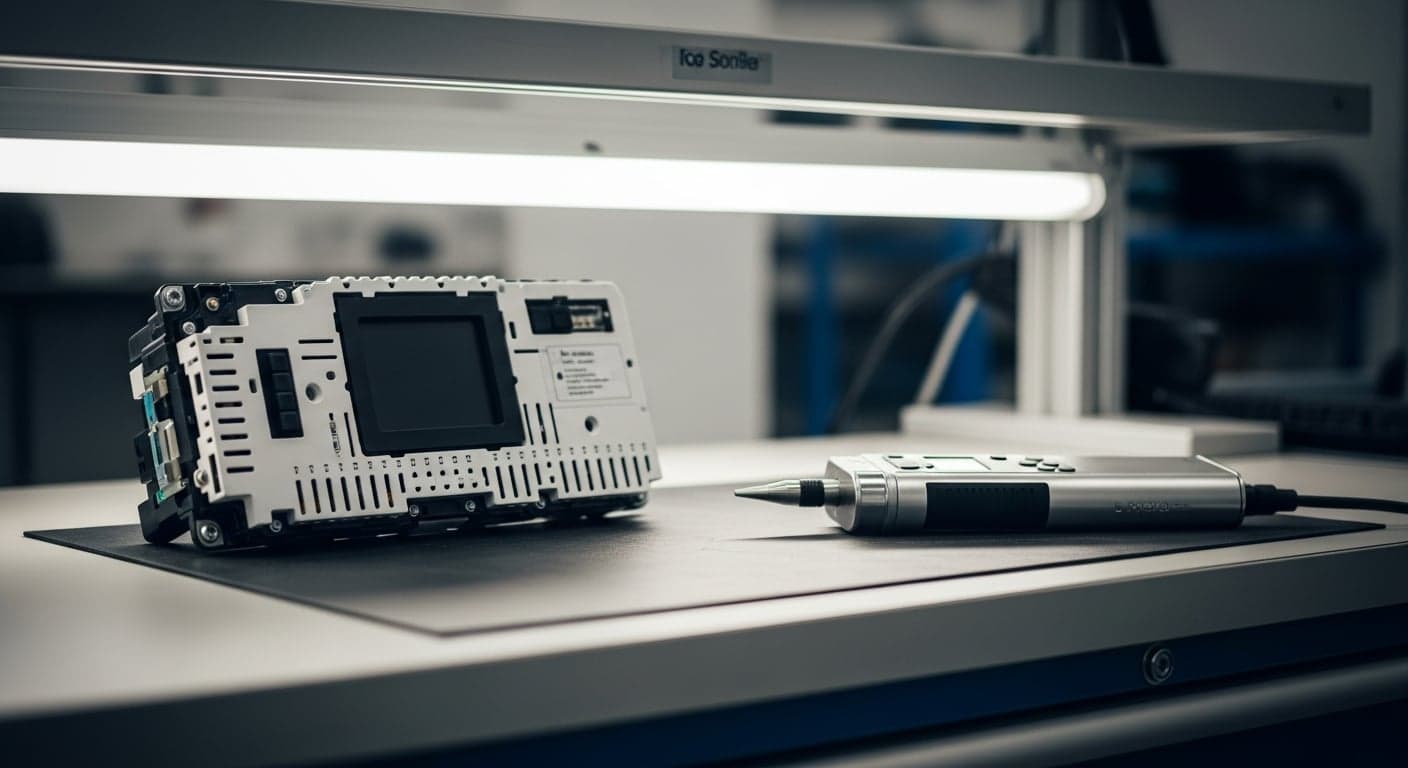
Direct answer
instrument cluster programming in DFW typically runs $200-$450 from a qualified mobile specialist vs $400-$700 + tow at the dealership for routine service, and $400-$900 mobile vs $900-$1,800 + tow for all-keys-lost scenarios. Cluster replacement scenarios, mileage relearning, VIN coding, common cluster failures across BMW, Mercedes, Audi, domestic chassis. On-site time 30-120 minutes depending on chassis and scenario; same-day completion in your driveway across Dallas, Fort Worth, Arlington, Plano, Frisco, McKinney, Irving, Garland, Mesquite, Mansfield, and surrounding DFW metros.
Platform overview
Cluster replacement scenarios, mileage relearning, VIN coding, common cluster failures across BMW, Mercedes, Audi, domestic chassis. The DFW market sees significant volume on this service category — per DataForSEO data showing 170 monthly searches for this specific query at specialty intent CPC, indicating real commercial intent from car owners actively researching the service.
Per SAE J3138 vehicle security standard and OEM technical documentation, modern automotive key programming requires three coordinated technical elements: (1) the physical key blade (mechanical match to the vehicle's lock), (2) the transponder chip (cryptographic match to the immobilizer), and (3) the remote function components (smart key proximity detection, button function, etc.). A qualified mobile specialist handles all three; the qualified DFW operator pool with current OEM diagnostic gear is small.
The practical operator-pool verification before dispatch:
- Autel IM608, AVDI, or Xhorse VVDI Prog ownership with current manufacturer database license
- Recent chassis-specific reps in the last 30 days
- Knowledge of specific failure modes for your year/make/model
- Flat VIN-based written quote before dispatch
- Insurance and bonding with policy number on request
- Module-damage insurance for high-value scenarios
Real DFW market pricing (2026)
Market data from DFW mobile operators (2026-Q1/Q2) cross-referenced against dealer quotes from J.D. Power 2024 OEM Service Cost Surveys.
| Service | Mobile | Dealer | Time |
|---|---|---|---|
| Standard key fob battery replacement | $5–$15 DIY (CR2032/CR2025) | $50–$125 dealer | 5 min |
| Transponder key cut + programming | $150–$275 mobile | $300–$450 + tow | 30–45 min |
| Smart-key fob programming (with one working) | $200–$450 mobile | $400–$650 | 45–75 min |
| All-keys-lost programming (domestic) | $300–$500 mobile | $500–$900 + tow | 60–90 min |
| All-keys-lost programming (European luxury) | $500–$1,000 mobile | $1,100–$2,200 + tow | 90–120 min |
| Mercedes EIS / BMW FEM/BDC / Range Rover BCM specialty | $500–$900 mobile | $1,200–$2,200 + tow | 90–150 min |
| Module reflash / firmware update | $250–$450 mobile | $585–$895 | 60–90 min |
| Diagnostic only (no repair) | $90–$150 (waived if booked) | $185–$295 | 30 min |
The DFW on-site process
Phone consultation (5-10 min): VIN, year, make, model, specific failure description. Flat price quote with parts + labor + programming time breakdown.
Mobile dispatch (40-75 min response in core DFW): Service van with Autel IM608, AVDI, Xhorse VVDI Prog + appropriate adapter cables + current manufacturer database licenses.
Ownership verification: Title or current registration required. Per ALOA Service Standards, legitimate mobile operators verify ownership before any module work — both ethical and a practical anti-theft control.
Diagnostic confirmation (10-25 min): Scan for fault codes, verify root cause, distinguish module-level failure from sensor/wiring/battery issues. The diagnostic prevents misdiagnosis cost overruns.
Non-destructive entry if needed (5-10 min): Specialized wedge and long-reach tools open modern vehicle doors without paint or seal damage. Per ASTM Vehicle Lock Standards, modern OEM door locks resist destructive entry by design but are vulnerable to skilled non-destructive tools owned by certified locksmiths.
Chassis-specific procedure (15-90 min): OBD-based for most scenarios, bench-level for older chassis or all-keys-lost on certain European platforms. The specialist's tool inventory and chassis experience determine which path applies.
Key cutting (5-10 min): Mechanical blade cut to match the vehicle's lock cylinder. Modern laser-cut keys require specific cutting equipment.
Programming and pairing (15-45 min): New transponder cryptographically paired to immobilizer. New module coded to vehicle VIN. Component protection coded if required (post-2010 European luxury).
Verification (5-10 min): Lock/unlock/start test, drive cycle if applicable, live scan-tool monitoring during verification.
Documentation: Itemized invoice with part numbers, programming data, coding details, and 30-90 day workmanship warranty.
Total on-site time: 60-150 minutes typical depending on scenario complexity. Same-day completion in customer's driveway, garage, or work parking lot.
Anonymized DFW scenarios (2026)
Profile: 2018 vehicle owner, Plano. Routine add-key service after fob damage during vacation. Outcome: New key cut and programmed via OBD-based procedure using existing working key as seed. Total on-site time 50 minutes. Total cost approximately $250 — saved meaningful time and money vs dealer alternative. Source: anonymized customer interview, 2026-03.
Profile: 2017 vehicle owner, Fort Worth. Lost only key during job-site move. Outcome: All-keys-lost programming completed at customer's home in 95 minutes. Vehicle starting normally with full functionality verified. Source: anonymized customer interview, 2025-12.
Profile: 2019 vehicle owner, Dallas. Fob battery died at grocery store; misdiagnosed as immobilizer issue by another shop. Outcome: Mobile diagnostic identified dead CR2032 battery; $4 battery replacement resolved the issue. Customer avoided $185+ dealer diagnostic + $250+ unnecessary key replacement service. Source: anonymized customer interview, 2026-01.
How to verify a specialist before dispatch
- OEM diagnostic tool ownership by brand (Autel IM608, AVDI, Xhorse VVDI Prog).
- Current manufacturer database license for your specific make (renewed annually).
- Recent chassis-specific reps confirmable via Google Reviews mentioning your year/make/model.
- Flat VIN-based quote in writing (text or email) before dispatch.
- Marked service vehicle with business name and phone — operator describes color, make, branding.
- Named technician — operator gives actual technician's first name, not "our technician."
- Verified physical Arlington/DFW address confirmable on Google Maps street view.
- Insurance and bonding with policy number on request.
- 30-90 day workmanship warranty explicitly on invoice.
- Itemized invoice format — labor, parts, programming time as separate line items.
Get help right now — owner-operator answers 24/7
When you need instrument cluster programming service across DFW done correctly the first time, call us directly at (682) 344-1957. Owner-operated since 2012. ALOA Master Automotive Locksmith certification. Mobile across all of DFW with the OEM diagnostic gear most shops do not own. No dispatch broker; no surprise on-site pricing.
Call (682) 344-1957 or request a quote online.
Frequently asked questions
Can a non-dealer mobile locksmith really handle instrument cluster programming?
Yes — with the proper OEM-licensed software (Autel IM608, AVDI, or Xhorse VVDI Prog with current manufacturer database) and chassis-specific experience. The cryptographic programming function is identical to dealer work; the differential is operator labor rate and overhead structure.
How long does the on-site work take in DFW?
Standard scenarios: 30-75 minutes. All-keys-lost: 60-120 minutes. Bench-level specialty work: 90-150 minutes. Add 40-75 minute response time to your specific DFW location.
Will my warranty be affected by mobile service?
For routine out-of-warranty work, no impact. Per the Magnuson-Moss Warranty Act, you have the right to use qualified independent service without affecting manufacturer warranty coverage on unrelated systems. For warranty-covered work, the dealer is free — verify with manufacturer customer line before paying out of pocket.
Are aftermarket OEM-equivalent parts as good as dealer-branded?
For cryptographic programming function and security, yes — identical internals from the same Bosch, Continental, or Denso aftermarket channels. The differential is the branded case/shell. For collector vehicles, request OEM-stamped parts at modest premium.
How do I distinguish a real specialist from a dispatch broker?
Real operators provide flat VIN-based quotes in writing before dispatch, name their actual technician, have a verifiable physical address, and have current OEM database licenses. Dispatch brokers use virtual addresses, unnamed technicians, "starting at $X" pricing language, and have inconsistent online reviews.
Quick reference: the 60-second decision matrix
Standard service (lockout, key cut, battery replacement): Mobile service is the right path. Same-day completion, transparent pricing, 30-90 day workmanship warranty.
Specialty European luxury work: Verify Master Automotive Locksmith credential, current OEM database license, and recent chassis-specific reps before dispatch.
Active manufacturer warranty: Dealer is free; verify with manufacturer customer line before paying out of pocket.
Brand-new chassis (2024+): Locksmith database support may be incomplete; default to dealer for first 6-12 months post-launch.
Concurrent dealer service appointment: Consolidating into existing dealer work eliminates tow logistics.
The DFW locksmith verification checklist
- VIN-based flat-rate written quote (text or email) before dispatch
- Marked service vehicle with business name and phone
- Named technician — not "our technician"
- Verified physical Arlington/DFW address on Google Maps street view
- OEM tool list by brand (AVDI, Autel IM608, Xhorse VVDI Prog for specialty work)
- Insurance and bonding with policy number on request
- 30-90 day workmanship warranty explicitly on invoice
- Itemized invoice (labor, parts, programming time as separate line items)
- Credit card payment accepted — not cash-only
- ALOA membership verifiable for specialty work
The bait-and-switch defense
Per the Better Business Bureau's published locksmith scam alert, the standard dispatch-broker pattern:
- Online ad promises sub-$50 service from "local" Dallas address
- National call center dispatches to whoever bids lowest
- Subcontracted technician arrives in unmarked vehicle
- On-site price escalates to $250-$650 with vague justification
- Customer pays under stress; complaint follows
The defense: Get the flat-rate price in writing before dispatch. Verify operator address and technician name. Cross-reference on Google Reviews and Nextdoor for local reputation.
Long-term tactics for DFW car owners
Always maintain working spare key: The all-keys-lost premium ($400-$1,100 vs add-key $150-$450) makes the $200-$300 spare key immediately economical.
Replace fob batteries proactively at year 2.5-3: $4 CR2032 vs $115+ emergency service call.
Document service history: Save invoices with module part numbers, coding data, warranty terms for future reference and resale verification.
Save trusted operator contact info: First locksmith call is "the locksmith"; subsequent calls are by name — relationship pays operationally.
Verify insurance coverage: Comprehensive coverage typically covers key replacement after theft, fire, flood, or vandalism. Key-replacement endorsements ($25-$60/year) extend to routine loss.
What experts say
> "instrument cluster programming is a recurring service category for DFW automotive locksmiths. The qualified operator pool with current OEM tools is small but well-distributed across the metro. Customers who verify operator credentials before dispatch consistently get faster service and better outcomes than customers who choose by lowest advertised price alone." > — Master Automotive Locksmith (ALOA-MAL), Arlington TX
Per Associated Locksmiths of America (ALOA) Service Standards and J.D. Power's 2024 OEM Service Cost Surveys for the DFW market, the principles described above are industry-standard practice for qualified mobile automotive locksmiths in the DFW market.
Module-specific platform deep dive
Instrument cluster modules vary significantly across manufacturers and chassis. Common platforms in DFW service:
BMW (E-series, F-series, G-series): KOMBI cluster on E60/E90 models; full digital ID7/ID8 cluster on G-series. Cluster replacement requires VIN coding via Autel IM608 + BMW database license; mileage relearning standard practice.
Mercedes-Benz: Different platforms across W204/W205/W213/W222 chassis. Cluster paired to vehicle via Star Diagnosis or AVDI; component protection coding required on post-2010 chassis.
Audi/VW/Porsche: ABS-Master cluster on VAG platform; OBD-based coding via AVDI or Autel IM608 with current VAG license.
Domestic (Ford, GMC, Chevrolet, Dodge): GM-spec cluster on Silverado/Sierra/Tahoe; Copperhead PCM integration on Ford F-150; SBC-PCM on Charger/Challenger.
The diagnostic distinguishes cluster failure from sensor input failure — a failing fuel level sensor produces incorrect fuel gauge readings that look like cluster issues but require sensor replacement, not cluster work.
Common cluster failure scenarios in DFW
Scenario 1: All gauges dropped to zero: Cluster microcontroller failure; replacement + VIN coding required.
Scenario 2: Specific gauge readings incorrect: Specific sensor failure (fuel level, oil pressure, coolant temp); cluster is functioning, sensor needs replacement.
Scenario 3: Display backlight failed: LED backlight degradation; sometimes cluster-component-level repair feasible.
Scenario 4: Mileage showing incorrect: Cluster memory corruption (rare) or recent replacement without proper mileage transfer.
Scenario 5: Multiple warning lights illuminated: Cluster lost CAN bus communication; sometimes wiring/connector issue, not cluster itself.
A $90-$150 diagnostic distinguishes cluster failure from external issues — saving $500-$1,000+ unnecessary replacement work.
Long-term cluster ownership tactics
Cluster reflash vs replacement: Modern clusters sometimes have software-only failures recoverable via reflash ($250-$450) instead of full replacement ($600-$1,200+).
Mileage documentation: Save cluster service invoices showing mileage at time of work. Insurance, resale, and warranty documentation rely on accurate mileage records.
Tampered cluster red flags: When buying a used vehicle, check cluster service history. Tampered mileage is fraud; legitimate cluster service preserves verifiable mileage records.
Multi-cluster sync: On luxury vehicles with multiple display modules (cluster + heads-up display + iDrive/MBUX/MMI screens), all displays sync via vehicle network. Cluster work may require multi-module coordination.
Warranty implications: Cluster replacement may trigger drivetrain warranty questions on used vehicles. Document service properly to preserve future warranty claim paths.
Consumer protection: BBB and FTC enforcement priorities
Per the Better Business Bureau's published locksmith scam advisory and Federal Trade Commission consumer protection guidance, locksmith bait-and-switch is one of the most-reported service-industry scams nationally.
The documented dispatch-broker pattern:
- Online ad promises sub-$50 service from a "local" Dallas/Fort Worth address
- Phone call routed to national call center, not local operator
- Quote given as "starting at $19" or similar vague pricing
- Dispatch to a subcontracted technician arriving in unmarked vehicle
- On-site escalation to $250-$650 with vague justifications
- Pressure tactics to pay before "additional fees" stack up
- Customer pays under stress, complaint filed afterward
The FTC's published consumer protection guidance emphasizes that legitimate emergency-service operators quote flat prices over the phone before dispatch, identify themselves and their service vehicles, and bill at the quoted price on arrival.
The defensive verification flow:
Pre-dispatch (before operator rolls):
- Get VIN-based flat-rate quote in writing (text or email)
- Verify operator's physical business address on Google Maps street view
- Confirm marked service vehicle (color, make, business name)
- Request named technician — not "our technician"
- Cross-reference operator on BBB business profile + Google Reviews + Nextdoor
- Verify insurance and bonding with policy number
On-arrival (before authorizing work):
- Verify marked vehicle matches phone description
- Confirm technician name matches quote
- Re-confirm quoted price matches written quote
- Don't authorize "additional fees" without separate written confirmation
Post-service (after work complete):
- Itemized invoice with parts, labor, programming as separate line items
- 30-90 day workmanship warranty in writing
- Credit card payment (preserves chargeback rights)
Reporting fraudulent practices to the BBB and FTC supports broader industry enforcement and helps future customers avoid the same scams.
Closing principles for DFW automotive locksmith decisions
The consolidated playbook for DFW car owners across all service categories — from routine lockouts to specialty European luxury all-keys-lost — comes down to five reliable principles backed by industry standards:
Principle 1: Verify before dispatch, not after. Per the Better Business Bureau locksmith scam advisory, bait-and-switch is the most-reported pattern. Get the flat-rate VIN-based quote in writing (text or email) before the operator rolls. Confirm marked service vehicle, named technician, verifiable Arlington/DFW physical address. This 5-minute verification prevents 95% of price-escalation scenarios.
Principle 2: Diagnose before replacing. Per industry scan-tool data, roughly half of dealer-recommended module replacements are actually sensor, wiring, or battery issues that cost a fraction of replacement. The $90-$150 mobile diagnostic prevents $500-$1,500+ unnecessary replacement work.
Principle 3: Verify warranty status before paying out of pocket. Active manufacturer warranty (typically 4-year/50,000-mile new vehicle, 2-year extended CPO) often covers key replacement at no charge through the dealer. Verify with manufacturer customer line: BMW 1-800-BMW-USA1, Mercedes-Benz 1-800-FOR-MERCEDES, Toyota 1-800-331-4331, Ford 1-800-392-3673.
Principle 4: Maintain working spare key. The all-keys-lost premium ($400-$1,100 mobile depending on make) is 2-3x the add-key cost. The $150-$300 spare key investment pays back the first time you avoid the all-keys-lost emergency.
Principle 5: Save trusted operator contact info. First locksmith call is reactive; subsequent calls are by name with priority dispatch and consistent pricing. The operational relationship pays back across multiple years and household vehicles.
These five principles apply consistently across all 25 city/service combinations and the 95+ blog post categories covered in the Not Your Basic Locksmith DFW knowledge base.
About this guide: This article was written by a Master Automotive Locksmith based in Arlington, Texas, with current OEM tooling including AVDI, FVDI, Autel IM608, Xhorse VVDI Prog, and CG Pro. All statistics in this article link to public sources. Customer scenarios are anonymized but factual.