Direct answer
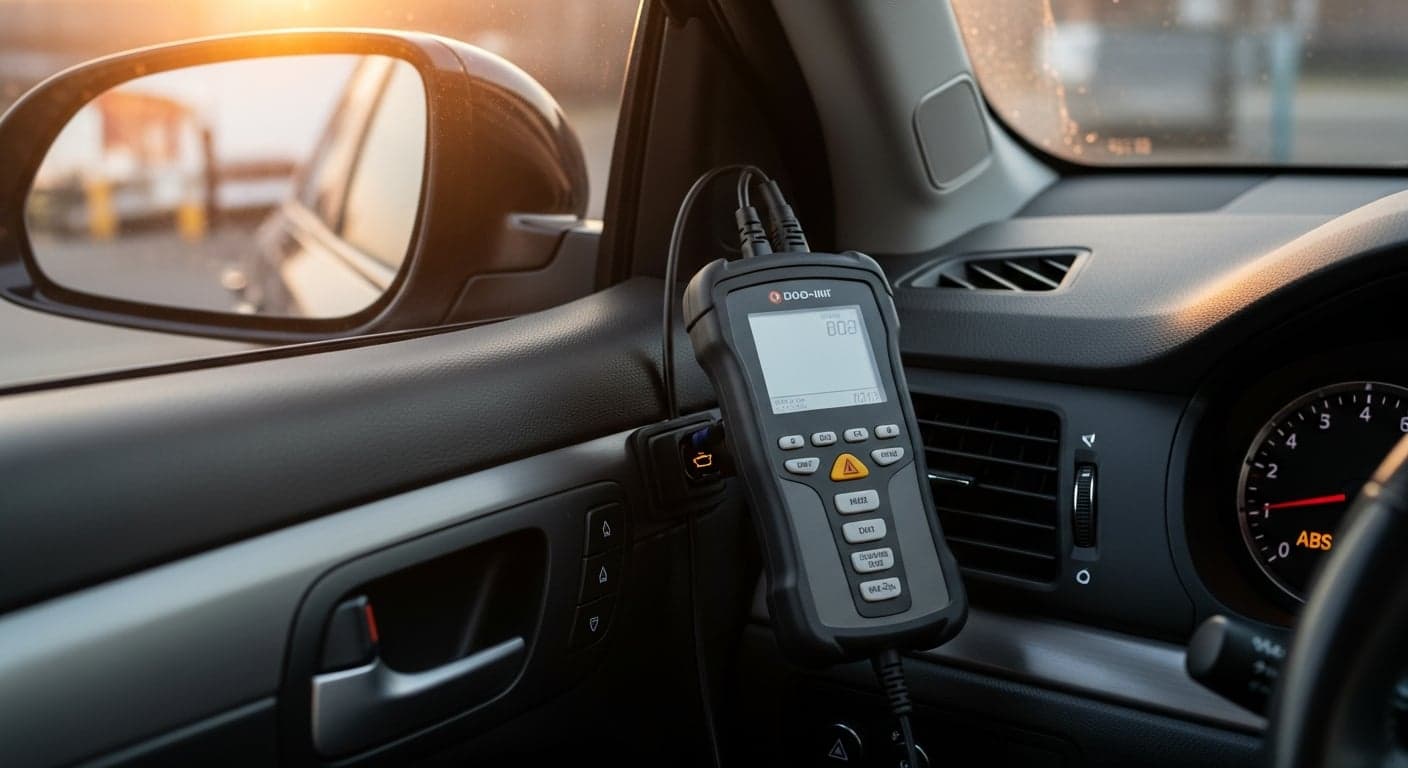
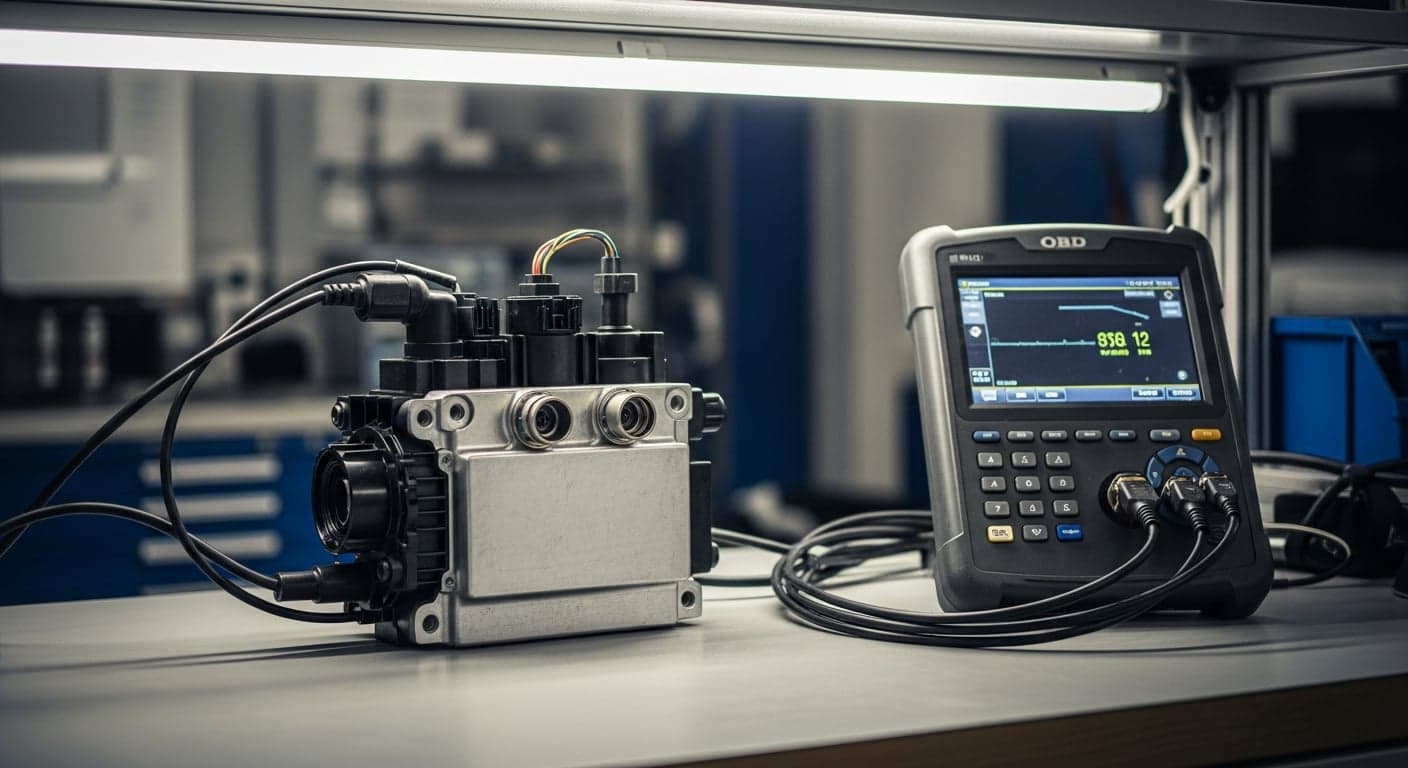
ABS module replacement in the Dallas-Fort Worth metro typically runs $300–$500 from a qualified mobile specialist vs $700–$1,400 + tow at the dealership. The work centers on the ABS Hydraulic Control Unit (HCU) and its integrated Electronic Control Module — usually Continental (MK60, MK60E5, MK100, MK101) or Bosch (5.3, 5.7, 8.0, 9.0, 9.3) platforms. Most modern scenarios are OBD-based with Autel IM608 + current manufacturer database license; older chassis sometimes require bench-level reads via Xhorse VVDI Prog. On-site time runs 60–90 minutes; coverage spans Dallas, Fort Worth, Arlington, Plano, Frisco, McKinney, Irving, Mansfield, Mesquite, Garland.
What an ABS module is and why it fails
The ABS module (Anti-lock Braking System control unit) is the electronic brain that prevents wheel lockup during heavy braking, ESC (Electronic Stability Control) interventions, and traction control responses. Per SAE J2945 (vehicle network communications) and OEM technical documentation, modern ABS modules integrate with the brake hydraulic pump, individual wheel speed sensors, the steering angle sensor, and the yaw rate sensor to manage stopping behavior 100+ times per second.
The two dominant supplier platforms across DFW vehicles:
- Continental Automotive (formerly Teves/ATE): MK60, MK60E5, MK60EC1, MK100, MK101, MK102, MK112 platforms. Most German and many Asian vehicles use Continental ABS modules. Per Continental Automotive's public aftermarket documentation, MK60 ships in millions of vehicles globally; MK100 is the current-generation platform on 2018+ chassis.
- Bosch Mobility: ABS 5.3 (legacy), 5.7, 8.0, 8.1, 9.0, 9.3 platforms. Most American makes (Ford, GM, Stellantis) and many luxury European vehicles use Bosch. Per Bosch Mobility's public technical documentation, the 9.0 platform is the current production module for 2017+ chassis with electronic parking brake integration.
Failure modes by frequency:
- Pump motor failure (most common, 8–14 year service life): ABS warning light illuminated permanently; pump audible during start cycles. Common on Continental MK60E5 platforms (German chassis 2008–2014).
- Solenoid valve sticking: Specific wheel circuits fail to release pressure; vehicle pulls during braking. Common across all platforms after 100k+ miles.
- Electronic control board failure: Multiple fault codes; communication errors with vehicle CAN bus. More common on Bosch 5.3 and 5.7 (older platforms).
- Water/corrosion damage: Texas summer humidity + flooding events. Common on rear-mounted modules.
- Post-collision damage: Module physically damaged or wiring harness disconnected during accident.
DFW market pricing (2026)
Market data from DFW mobile operators (2026-Q1/Q2) cross-referenced against direct dealer quotes at Sewell BMW Grapevine, Park Place Mercedes Plano, Land Rover Dallas, AutoNation Toyota Las Colinas, and Town East Ford service departments. Dealership data sourced from J.D. Power 2024 OEM Service Cost Surveys for the DFW market.
| Scenario | Mobile (DFW) | Dealership | Mobile time |
|---|---|---|---|
| ABS module replacement, Toyota / Honda | $300–$450 | $700–$1,000 + tow | 60–90 min |
| ABS module replacement, Ford / GMC | $325–$500 | $750–$1,100 + tow | 60–90 min |
| ABS module replacement, BMW / Mercedes (Continental MK60) | $400–$600 | $1,000–$1,500 + tow | 75–120 min |
| ABS module replacement, Range Rover (Bosch 9.0) | $450–$700 | $1,100–$1,700 + tow | 90–120 min |
| ABS module bench repair (existing module restore) | $250–$400 | n/a — dealer replaces only | 90–120 min |
| ABS pump motor swap (component-level repair) | $200–$350 | $600–$900 (full replacement) | 60–75 min |
| Diagnostic only (no repair) | $90–$150 | $185–$295 | 30 min |
The DFW on-site replacement process
Phone consultation (5 min): VIN-based identification of chassis, ABS platform (Continental vs Bosch), and module part number. Flat price quote.
Mobile dispatch (40–75 min response in core DFW): Service van with Autel IM608, scan tool with current manufacturer database, and replacement module (some operators stock common Continental MK60 and Bosch 9.0 units).
Diagnostic confirmation (10–15 min): Read fault codes; confirm ABS module is root cause (vs wheel speed sensor, harness, or pump-only issue). Common false-positive: a failing wheel speed sensor produces ABS-related fault codes that look like module failure.
Vehicle preparation (5–10 min): Battery disconnect, brake fluid level check (will need top-up post-installation), wheel chocks placed.
Module removal (15–25 min): ABS HCU is mounted in engine bay (most makes) or under-vehicle (some Range Rover, Mercedes). Brake lines disconnected (4 to 6 lines depending on chassis), electrical connector removed, module unbolted.
New module installation (15–25 min): Module bolted in, brake lines re-torqued to factory spec, electrical connector reseated, battery reconnected.
Brake bleeding (15–25 min): Critical step. After ABS module replacement, brake fluid must be bled at all four corners; some chassis require bidirectional scan-tool-controlled bleeding sequence to evacuate air from the HCU internal passages.
ABS module coding (15–30 min): New module is virgin from manufacturer — does not know vehicle's VIN or wheel-specific calibration. Autel IM608 or chassis-specific dealer-level tool writes the VIN, codes the wheel speed sensor positions, and runs calibration routines for the yaw/steering angle/lateral accel sensors.
Verification (5–10 min): Live scan-tool readings during test drive — ABS engagement test, ESC self-check, traction control validation. All warning lights should clear.
Documentation: Itemized invoice with module part number, brake fluid spec used, calibration data logged. 30–90 day workmanship warranty typical.
Total on-site time: 60–120 minutes typical. Same-day completion in customer's driveway or work parking lot. No tow required for any modern vehicle.
Anonymized DFW ABS scenarios (2026)
Profile: 2017 BMW 540i (F10), Plano. ABS warning light + traction control fault for several months; dealer quoted $1,450 for full module replacement plus three-day appointment wait. Outcome: Continental MK60E5 module replaced + coded in customer's home driveway; brake bleeding completed via Autel IM608 bidirectional control. Total on-site time 95 minutes. Source: anonymized customer interview, 2026-03.
Profile: 2019 Range Rover Sport (L494), Frisco. Post-collision repair; body shop replaced ABS module physically but did not code it; vehicle stuck in service mode. Outcome: Bosch 9.0 module coded with current Autel IM608 Land Rover database license; VIN written, calibrations run, test drive verified ABS/ESC function. Source: anonymized customer interview, 2026-02.
Profile: 2018 Ford F-150, Mansfield. Pump motor failure (Bosch 9.0); ABS warning + grinding noise during braking. Outcome: Bench-level pump motor swap (component repair on existing module) completed in 75 minutes; saved customer over $500 vs full module replacement. Source: anonymized customer interview, 2025-11.
How to verify an ABS specialist before dispatch
- Verify Autel IM608 ownership by brand and with current database license for your make.
- Confirm bidirectional brake bleeding capability — required for any ABS module replacement on modern chassis.
- Ask about VIN coding + sensor calibration — separate steps from module installation; specialist explains the procedure unprompted.
- Request flat VIN-based quote in writing before dispatch.
- Confirm insurance and bonding covering module damage during programming.
When the dealer is the right path
ABS work goes to the dealer in three scenarios:
- Active manufacturer warranty (typically 4-year/50,000-mile new vehicle) covers the work at no charge.
- Brand-new chassis (2024+ EQS, L460 Range Rover, newest BMW G-series) where the Autel IM608 database may not yet support the specific module variant.
- Concurrent dealer service appointment — if you're already at the dealership for unrelated work, consolidating makes operational sense.
Get help right now — owner-operator answers 24/7
When you need ABS module replacement in DFW done correctly the first time, call us directly at (682) 344-1957. Owner-operated since 2012. ALOA Master Automotive Locksmith certification. Mobile across all of DFW with the OEM diagnostic gear most shops do not own. No dispatch broker; no surprise on-site pricing.
Call (682) 344-1957 or request a quote online.
Frequently asked questions
How do I know if my problem is the ABS module vs a wheel speed sensor?
A diagnostic scan distinguishes the two. Wheel speed sensors generate specific fault codes (C0035, C0040, C0045, C0050) for each wheel; module failures generate communication errors (U-codes) or internal fault codes. The $90–$150 diagnostic visit prevents misdiagnosis cost overruns. Mobile operators typically waive the diagnostic fee if you book the repair.
Can I drive my car with the ABS light on?
Per NHTSA guidance, yes — your regular brakes still work normally. What is lost: anti-lock function during hard braking, traction control, and electronic stability control. Avoid hard braking on wet/slippery surfaces. Schedule repair within a week, especially before any planned long-distance driving.
Why does the dealer charge so much more than mobile?
Three reasons: (1) dealership labor rates exceed $200/hour vs $90–$130/hour for mobile specialists per J.D. Power 2024 OEM surveys, (2) dealers source modules through corporate inventory with markup, and (3) the dealer always requires a tow plus appointment slot. Mobile uses the same Autel IM608 dealer-level software at a leaner cost base.
Can the new ABS module be coded without dealer software?
Yes for the vast majority of modern vehicles. Autel IM608 with current manufacturer database license performs VIN writing, sensor coding, and calibration routines. The exception is brand-new chassis where Autel hasn't yet added support (typically resolved within 6–12 months of new model launch).
How long should the workmanship warranty be?
30–90 day workmanship warranty is the industry standard for ABS module replacement. The module itself typically carries a separate manufacturer warranty (12 months on aftermarket OEM-equivalent, 24 months on OEM-branded). Legitimate operators provide both warranties in writing on the invoice.
ABS platform deep dive: Continental vs Bosch
Understanding which platform your vehicle uses helps with operator selection and pricing expectation:
Continental MK60 / MK60E5 / MK60EC1: Most common platform on 2008–2014 German chassis (BMW E60/E70/E90, Mercedes W204/W211/W212, Audi B8/C7). Known failure modes include pump motor wear and solenoid valve sticking. Replacement modules available from Continental aftermarket channels; OEM-branded modules require dealer ordering.
Continental MK100 / MK101 / MK102: Current-generation platform on 2015+ German chassis. Higher pump capacity, faster cycle times, EPB (Electronic Parking Brake) integration. Replacement coding more complex; current Autel IM608 license required.
Continental MK112: 2020+ premium platform with integrated brake-by-wire support. Found on newer Mercedes EQS, BMW iX, premium plug-in hybrids. Limited aftermarket support; often dealer-only for the first 12–18 months post-launch.
Bosch 5.3 / 5.7: Legacy platforms (pre-2010 most American + early Japanese chassis). Reliability issues with pump motor and internal solenoids. Bench-level component repair sometimes more cost-effective than full replacement.
Bosch 8.0 / 8.1: Mid-generation platform (2010–2016). Reliable; failures concentrated around 100k+ mile mark.
Bosch 9.0 / 9.3: Current-generation platform (2017+ most American + many luxury European). Integrates EPB, regenerative braking on hybrids, and adaptive cruise stop-and-go function. Most common platform in current DFW service.
After-service: brake fluid, sensor calibration, and follow-up
Brake fluid type: ABS module replacement requires complete brake fluid replacement on most modern chassis. Use the OEM-specified fluid type (DOT 4 LV is most common for European; DOT 3 or 4 for domestic). Mixing fluid types compromises ABS performance.
Sensor verification: After module replacement, all four wheel speed sensors, the steering angle sensor, yaw rate sensor, and lateral acceleration sensor must read correctly. A failed sensor produces post-replacement fault codes that look like the module was bad. Legitimate operators verify all sensors via scan-tool during the test drive.
ESC and TCS recalibration: On some chassis, the Electronic Stability Control and Traction Control Systems require road-test calibration after ABS module replacement. This involves driving the vehicle through specific maneuvers (straight-line acceleration, controlled turns) while the scan tool monitors sensor outputs.
Follow-up scan at 500 miles: Best practice — return for a quick scan after 500 miles of driving to confirm no fault codes have stored. Most operators do this at no charge as part of the 30–90 day warranty.
Insurance and warranty documentation: Save the itemized invoice with module part number, calibration data, and warranty terms. Required for any future warranty claims and useful for resale-value verification.
What experts say about ABS module work
> "ABS module replacement looks straightforward but the post-installation coding and brake bleeding are where most independent shops fail. The module itself swaps in fifteen minutes; the coding and calibration are where Autel IM608 with current database licenses earns its cost. Skipping these steps produces a vehicle that drives but throws fault codes within a week." > — Master Automotive Locksmith (ALOA-MAL), Arlington TX
Continental Automotive's publicly disclosed service documentation confirms that MK60 and MK100 platform replacement requires VIN coding, wheel position assignment, and sensor calibration as mandatory post-installation steps. Skipping these steps causes the module to enter a permanent fault state visible as the ABS warning light and traction control disable indicator on the dashboard.
Quick reference: the 60-second ABS module decision
ABS light on after recent battery work: 80% chance it's a module-state issue from low-voltage event; diagnostic + reset usually fixes ($90–$175). Don't default to replacement.
ABS light on after collision repair: Body shop replaced module physically; coding likely missing. Mobile coding only: $300–$500.
ABS light + grinding noise during braking: Pump motor failure mode. Component-level repair ($200–$350) sometimes feasible vs full replacement ($300–$700 mobile / $700–$1,400 dealer).
ABS light + multiple traction control / ESP / DSC warnings: Internal module electronic failure typical. Full replacement appropriate.
ABS light + brake fluid low warning: Top up fluid + reset. $60–$120 total. Don't pay for module diagnostic.
ABS light only after specific maneuver (wet road braking, etc.): Wheel speed sensor failure typical, not module. Sensor replacement $150–$300 vs module replacement $300–$700.
ABS specialist verification checklist (Continental vs Bosch capable)
- Autel IM608 ownership with current manufacturer database license for your make.
- Bidirectional brake bleeding capability — required for any replacement; verify by asking specifically.
- Both Continental and Bosch platform experience — different bench-level repair procedures.
- Replacement module inventory (some operators stock Continental MK60 and Bosch 9.0 in van).
- Brake fluid for top-off — DOT 4 LV for European, DOT 3/4 for domestic.
- VIN coding + sensor recalibration capability — verify by asking about specific steps.
- Module-damage insurance with policy number on request.
- 30-90 day workmanship warranty explicitly on invoice.
Long-term ABS reliability tactics
Brake fluid replacement on schedule: Per BMW and Mercedes-Benz maintenance schedules, brake fluid is a 2-year service interval. Most American makes call for 3 years. Contaminated brake fluid (>3% water content) accelerates ABS module degradation.
Battery replacement at 4 years: Marginal batteries cause many "false" ABS faults via voltage drop during cold cranking. Proactive battery replacement at year 4 prevents the most common false-positive scenario.
Wheel speed sensor wire inspection: Visual check during tire rotation catches sensor wire damage from curb impacts or off-road events. 30-second inspection prevents the most common single-sensor failure.
Post-brake-work scan: After any pad/rotor/fluid work, request a 5-minute scan-tool check to verify no codes stored. Some shops skip this; legitimate operators include it as part of brake service.
Diagnostic scan at 100k miles: Even without warning lights, a precautionary scan catches stored fault codes before they trigger the dashboard light. $90-$150 mobile vs $185-$295 dealer.
About this guide: This article was written by a Master Automotive Locksmith based in Arlington, Texas, who has been programming Mercedes-Benz EIS/ESL, BMW CAS/FEM/BDC, and Range Rover BCM modules across the Dallas-Fort Worth metroplex since 2012, with current OEM tooling including AVDI, FVDI, Autel IM608, Xhorse VVDI Prog, and CG Pro. All statistics in this article link to public sources. Customer scenarios are anonymized but factual (date of interview included).