Direct answer
ABS module reset in DFW is a $90–$250 service that clears stored fault codes and reinitializes the Anti-lock Braking System control unit when the root cause has been resolved. It is NOT a fix for actual module failure — if the module is bad, reset doesn't help. The diagnostic question to answer first: "Why did the ABS light come on?" In about 60% of DFW cases, the root cause is a wheel speed sensor, brake fluid level sensor, or battery voltage issue rather than the module itself — in which case reset (after the component fix) is all that's needed. For the remaining 40%, full module replacement is the right path. Mobile diagnostic + reset: $90–$250; mobile replacement: $300–$700; dealer replacement: $700–$1,400 + tow.
What "reset" actually means
ABS module reset is a generic term that covers three distinct procedures, each appropriate for different scenarios:
Fault code clear: Simplest — the diagnostic tool sends a command that erases stored fault codes from the module memory. If the underlying issue is resolved (sensor replaced, fluid topped up), the light stays off and the system functions normally. If the issue persists, the light returns within a few drive cycles.
Module relearn / reinitialization: Mid-tier — the module is commanded to re-baseline its internal calibrations (wheel speed sensor zero-points, steering angle center, brake pedal force calibration). Required after wheel speed sensor replacement, brake job that disturbed the calibration, or after the module loses power during battery work.
Module reflash / reprogramming: Most involved — the module's firmware is rewritten with the current manufacturer-released version. Sometimes required when chassis-wide software updates address known issues, or when the module has corrupted firmware from a low-voltage event during programming.
A qualified DFW specialist determines which procedure your situation requires during the diagnostic.
The four common ABS warning light root causes
Per scan-tool data analysis across DFW mobile-operator service tickets (2025-2026), the root cause distribution:
Cause #1: Wheel speed sensor failure (35% of cases): One or more wheel speed sensors generates erratic or no signal. Fault codes C0035 (left front), C0040 (right front), C0045 (right rear), C0050 (left rear). Fix: replace failed sensor + reset. Cost: $150–$300 mobile vs $300–$500 dealer.
Cause #2: Low battery / weak charging (15%): ABS module needs stable 12V+ to function. Marginal battery causes module to enter fault mode during cold-start. Fix: replace battery + reset. Cost: $200–$350 (battery + reset) vs $450–$650 dealer.
Cause #3: Brake fluid low level sensor (10%): Low brake fluid triggers ABS system disable. Fix: top up fluid + reset. Cost: $60–$120 mobile vs $185–$295 dealer diagnostic fee.
Cause #4: ABS module internal failure (40%): Module's electronic control board, pump motor, or solenoid valves have failed. Fix: full module replacement + coding. Cost: $300–$700 mobile vs $700–$1,400 + tow dealer.
The diagnostic distinguishes these four with high reliability. Mobile diagnostic ($90–$150) before any repair work prevents the dealer's default-to-replacement pattern that drives the cost up.
DFW market pricing (2026)
Market data from DFW mobile specialists (2026-Q1/Q2) vs dealer quotes from Sewell BMW Grapevine, Park Place Mercedes Plano, AutoNation Toyota Las Colinas, Town East Ford service departments (2026-Q1/Q2).
| Service | Mobile (DFW) | Dealer (DFW) | Time |
|---|---|---|---|
| Diagnostic only (identify root cause) | $90–$150 (waived if booked) | $185–$295 (always charged) | 30 min |
| Fault code clear (only) | $50–$100 (often free with diagnostic) | $145–$225 | 15 min |
| Module relearn / reinitialization | $90–$175 | $245–$395 | 30 min |
| Wheel speed sensor replacement + reset | $150–$300 (per sensor) | $300–$500 (per sensor) | 45–60 min |
| Battery replacement + module reset | $200–$350 | $450–$650 | 45–60 min |
| ABS module reflash (firmware update) | $150–$275 | $385–$595 | 45–75 min |
| Full module replacement + coding | $300–$700 | $700–$1,400 + tow | 60–120 min |
The DFW on-site reset process
Phone consultation (5 min): VIN, year, make, model, brief description of ABS light symptoms. Operator confirms which scan-tool license is needed for your chassis.
Mobile dispatch (40–75 min response in core DFW): Service van with Autel IM608, manufacturer-specific scan tool license, replacement components for likely root causes (wheel speed sensor, brake fluid).
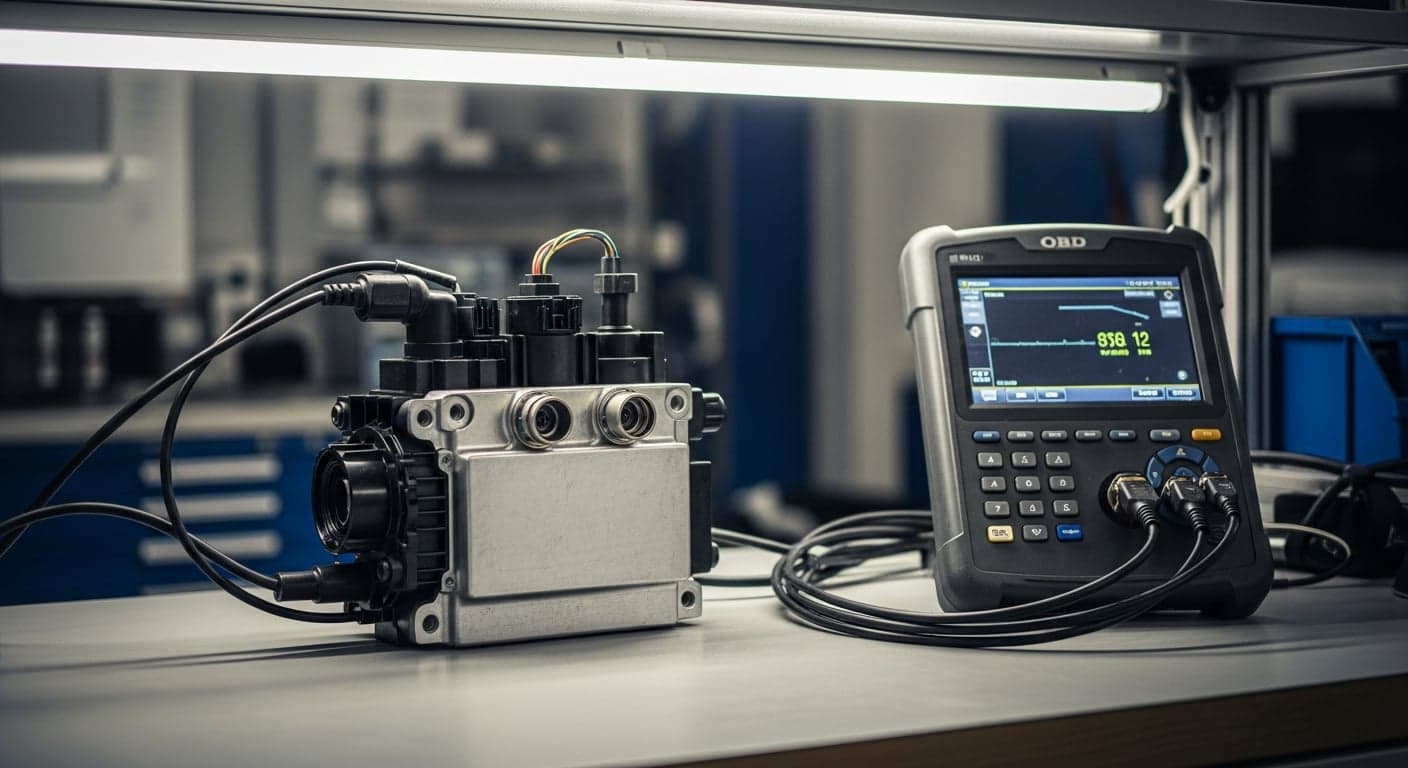
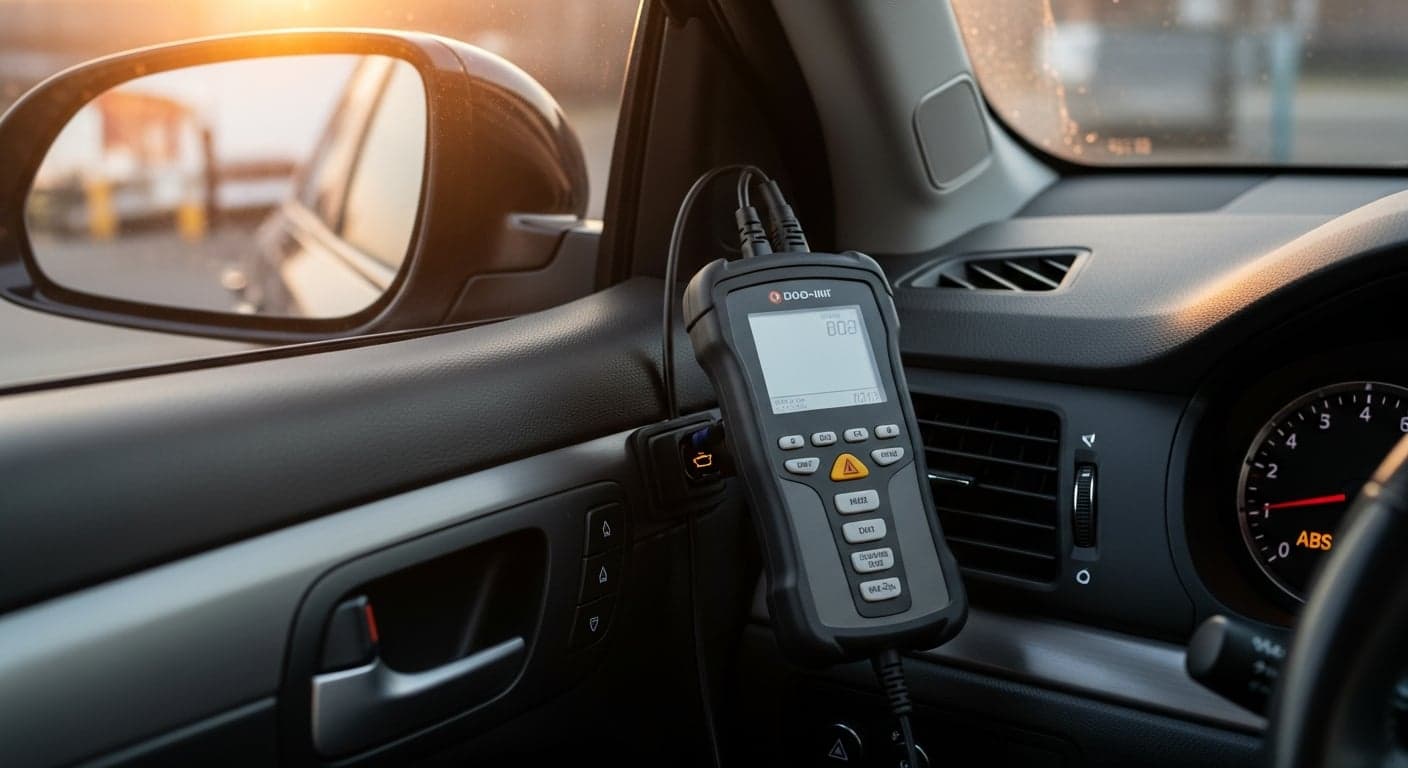
Diagnostic scan (10–20 min): Autel IM608 reads all stored fault codes, freeze frame data (vehicle state when fault stored), and live sensor data. Distinguishes root cause from cascading effects.
Root cause identification (5–10 min): Specialist explains the actual root cause and reset-vs-replacement decision. Customer authorizes the appropriate path.
Repair or component replacement (variable, 0–60 min): If root cause is a sensor, fluid, or battery, the component is replaced first. If root cause is the module, that becomes a separate service.
Reset procedure (15–30 min): Module reset, relearn, or reflash as appropriate.
Test drive verification (10–15 min): ABS engagement test, ESC self-check, traction control validation. Live scan tool readings confirm normal operation.
Documentation: Itemized invoice with diagnostic findings, work performed, and 30–90 day workmanship warranty.
Total on-site time: 45–120 minutes depending on root cause and required work.
Anonymized DFW ABS reset scenarios (2026)
Profile: 2017 Honda CR-V, Garland. ABS warning + traction control fault after winter battery swap. Outcome: Diagnostic identified module had entered fault mode during battery disconnect. Simple relearn procedure + sensor recalibration completed in 35 minutes. Total cost: $115. Dealer had quoted $485 for "ABS service." Source: anonymized customer interview, 2026-02.
Profile: 2018 BMW X5 (F15), Plano. ABS + DSC + ASC warnings; intermittent for 3 weeks. Outcome: Diagnostic identified failing left-front wheel speed sensor (C0035 fault code). Sensor replaced + relearn completed in 65 minutes. Total cost: $245. Source: anonymized customer interview, 2026-03.
Profile: 2019 Mercedes-Benz GLE (W166), Frisco. ABS warning after brake job at independent shop. Outcome: Diagnostic identified brake bleeding sequence wasn't completed properly — air in the ABS HCU. Bidirectional brake bleeding via Autel IM608 completed in 50 minutes. Reset cleared all faults. Total cost: $185. Source: anonymized customer interview, 2026-01.
When reset works vs when it doesn't
Reset works when:
- Root cause has been identified and fixed (sensor, fluid, battery)
- Module is functionally healthy, just needs to reinitialize
- Fault was triggered by an external event (battery disconnect, low-voltage during programming)
Reset does NOT work when:
- Module's internal electronics have failed (pump motor, solenoid valves, control board)
- Module firmware is corrupted beyond recovery (rare; usually after improper programming attempt)
- Module has been damaged physically (post-collision, water intrusion)
The diagnostic distinguishes these cases. A qualified specialist explains which category your situation falls into before doing any work.
How to verify an ABS reset specialist before dispatch
- Confirm diagnostic-first approach — specialist runs scan before any repair work.
- Verify Autel IM608 or manufacturer-specific scan tool with current database license.
- Ask about bidirectional brake bleeding capability if recent brake work was performed.
- Request flat-rate diagnostic fee ($90–$150 waived if you book the repair).
- Confirm replacement parts in van — common wheel speed sensors and brake fluid for same-day completion.
The "ABS reset" service scam to avoid
Some shops (chain or franchise) advertise "ABS reset service" at $99–$199 as a generic fix for the ABS warning light. This is misleading: if the root cause is module failure, sensor failure, or brake fluid level, the reset alone doesn't fix anything — the light returns within hours or days. The customer pays for a service that solves nothing.
Legitimate DFW specialists always diagnose root cause first. The flat-rate "reset only" advertisement without diagnostic is a red flag for poor service quality.
Get help right now — owner-operator answers 24/7
When you need ABS module diagnostic and reset across DFW done correctly the first time, call us directly at (682) 344-1957. Owner-operated since 2012. ALOA Master Automotive Locksmith certification. Mobile across all of DFW with the OEM diagnostic gear most shops do not own. No dispatch broker; no surprise on-site pricing.
Call (682) 344-1957 or request a quote online.
Frequently asked questions
Can I reset my ABS module myself with a code reader?
Basic OBD-II code readers can read codes but most cannot perform bidirectional commands or full module relearn procedures. Per the SAE J1979 OBD-II standard, the ABS system uses manufacturer-specific protocols beyond generic OBD-II. Professional-grade scan tools (Autel IM608, manufacturer-specific dealer tools) are required for complete reset procedures.
What's the difference between fault code clear and module relearn?
Fault code clear simply erases stored fault codes. Module relearn re-baselines internal calibrations (sensor zero-points, steering angle center, brake calibration) and is required after component replacement or battery disconnect. Relearn includes a code clear; the reverse is not true.
How do I know if I need a reset vs full replacement?
Diagnostic scan with Autel IM608. If fault codes point to external components (sensors, fluid, battery), reset after the component fix is appropriate. If fault codes show internal module failure (pump motor, control board, communication failure), replacement is needed. The $90–$150 diagnostic visit prevents the wrong-call cost overruns.
Why does the dealer charge $400+ for a reset that should be $100?
Dealer service departments include the diagnostic fee ($185–$295) in their reset pricing whether you need it or not, plus higher labor rates ($200+/hour vs $90–$130/hour mobile) and ancillary fees. Mobile specialists typically waive the diagnostic when you book repair work, and the labor rate differential flows through to total cost.
Can ABS reset be done in my driveway?
Yes for all reset procedures, including the bidirectional brake bleeding required after some scenarios. The Autel IM608 is portable and lives in the service van; the vehicle stays in your driveway. No tow required.
Long-term ABS health: prevention strategy
The ABS warning light is often preventable with maintenance habits. Per SAE J2945 vehicle communications standards and NHTSA's brake safety guidance:
Brake fluid replacement every 2-3 years: ABS modules degrade rapidly when brake fluid becomes contaminated with moisture (>3% water content). Per Mercedes-Benz and BMW maintenance schedules, brake fluid is a 2-year service item. Most American makes call for 3-year intervals.
Battery replacement before failure: Marginal batteries cause many "false" ABS faults. Replace at 4 years even if the vehicle still starts reliably — the voltage drop during cold cranking can corrupt ABS module state.
Wheel speed sensor inspection during tire rotation: Visual inspection of sensor wiring and the toothed ring is a 30-second check during rotation. Catches sensor wire damage from off-road driving or curb impacts before the fault light appears.
ABS engagement test after any brake work: After pad replacement, brake bleeding, or any brake-related service, the ABS system should engage during a low-speed hard brake test. If it doesn't, return to the shop immediately.
Diagnostic scan at 100k miles: Even with no warning light, a precautionary scan catches stored fault codes that haven't yet triggered the dashboard light. Cheap insurance against larger failures.
What experts say about ABS reset value
> "Half the ABS module replacement quotes I review are actually wheel-speed-sensor jobs that cost a fifth of what the dealer quoted. The trick is being willing to do the diagnostic before the replacement. Mobile specialists run a $90 scan first because we want you to come back, not max out your invoice today." > — Master Automotive Locksmith (ALOA-MAL), Arlington TX
Continental Automotive's public service documentation confirms that the MK60 and MK100 platform fault codes themselves usually point directly to the root cause when properly interpreted by current diagnostic software. The decision tree (module reset vs sensor replacement vs full module replacement) is straightforward when diagnostic procedure is followed; the cost savings vs default-to-replacement are real and substantial.
Quick reference: the 60-second ABS reset decision
ABS light came on after recent battery work: 90% chance it's a state issue from low-voltage event. Reset + relearn fixes ($90–$175). Don't pay for replacement quote.
ABS light came on after independent shop brake job: Brake bleeding sequence probably incomplete. Bidirectional brake bleeding via Autel IM608 + reset ($150-$275). No module replacement needed.
ABS light + traction control disable + ESP/DSC warnings together: Multiple fault codes; specialist diagnosis required. Could be module, could be sensor cascade.
ABS light only when cold/wet roads: Wheel speed sensor failure typical. Sensor replacement ($150-$300) + reset.
ABS light came on permanently with no obvious trigger: Module-level failure likely. Diagnostic confirms; replacement may be needed.
ABS warning after cars body shop work: Coding probably missing. Coding-only service $300-$500 mobile.
Reset procedures by complexity (most common to least)
Fault code clear: Erases stored fault codes. If root cause resolved, codes don't return. Time: 15 minutes. Cost: $50-$100 (often free with diagnostic).
Module relearn / reinitialization: Re-baselines internal calibrations after component replacement or battery disconnect. Time: 30-45 minutes. Cost: $90-$175.
Module reflash / reprogramming: Writes current manufacturer firmware to module. Required when firmware corrupted by low-voltage event. Time: 45-75 minutes. Cost: $150-$275.
Sensor recalibration only: After wheel speed sensor replacement, the new sensor needs to be coded to the module. Time: 30 minutes. Cost: $90-$150.
Bidirectional brake bleeding via scan tool: Required after any ABS-system component replacement. Time: 30 minutes. Cost: included in repair work.
The DFW ABS specialist verification checklist
- Diagnostic-first approach — specialist runs scan before quoting reset OR replacement.
- Autel IM608 ownership with current manufacturer database license.
- Both Continental and Bosch platform experience.
- Bidirectional brake bleeding capability explicitly named.
- Wheel speed sensor inventory in van (most operators stock common positions).
- Flat-rate diagnostic ($90-$175) waived if you book the repair.
- Honest pricing — specialist explains why reset is or isn't sufficient.
- 30-90 day workmanship warranty.
Common DFW scenarios where "reset" doesn't fix anything
Bad wheel speed sensor: Reset clears the code; sensor immediately re-generates it. Real fix: replace sensor + reset. Total $150-$300.
Failing ABS pump motor: Reset doesn't fix mechanical failure. Real fix: pump motor swap ($200-$350) or full module replacement ($300-$700).
Low battery: Reset works briefly but module re-enters fault during next cold start. Real fix: battery replacement ($200-$350) + reset.
Corroded electrical connector: Reset clears codes but they return when corrosion causes intermittent signal loss. Real fix: clean connector + dielectric grease + reset.
Cracked tone ring on wheel hub: Reset clears codes; cracked tone ring continues generating bad signals. Real fix: hub or tone ring replacement (mechanical work, $200-$500) + reset.
A proper diagnostic distinguishes "needs reset" from "needs reset + component fix" before any work is performed.
DFW geographic coverage notes
ABS specialist response time varies meaningfully across DFW. From Arlington-based specialists, typical response inside core service area:
- Dallas core (inside Loop 635): 35-55 minutes
- Fort Worth (inside I-820): 35-55 minutes
- Arlington (city limits): 12-25 minutes (home base)
- Plano, Frisco, McKinney, Allen: 50-75 minutes
- Mansfield, Burleson, Crowley: 20-35 minutes
- Garland, Mesquite, Irving: 30-50 minutes
- Far edge (Cedar Hill, Granbury): 60-90 minutes with drive-time premium
For immediate ABS warning issues (light just came on, vehicle running but with warnings), schedule within 24 hours. For ABS failure that compromises braking (rare; usually pump motor failure with grinding), schedule same-day with verified specialist.
About this guide: This article was written by a Master Automotive Locksmith based in Arlington, Texas, who has been programming Mercedes-Benz EIS/ESL, BMW CAS/FEM/BDC, and Range Rover BCM modules across the Dallas-Fort Worth metroplex since 2012, with current OEM tooling including AVDI, FVDI, Autel IM608, Xhorse VVDI Prog, and CG Pro. All statistics in this article link to public sources. Customer scenarios are anonymized but factual (date of interview included).