Water Damage in European Modules
When a BMW, Mercedes, Audi or Range Rover starts producing electrical faults that make no sense together — the key stops being recognised, the windows do what they like, the lights half work, the car will not start on a Tuesday and starts fine on a Wednesday — water is one of the first things an experienced technician checks and one of the last things most owners suspect. As of August 2026 in Dallas–Fort Worth the outcomes run from a $90–$150 diagnostic read and a cleared drain, through a $250–$450 bench repair on a corroded module, to a $500–$1,800 replacement with coding when a board is genuinely gone.
The reason this matters financially is simple: a water-damaged module that gets replaced without finding the leak will be damaged again. The repair is not the module. The repair is the drain, and then the module.
Why this is a DFW problem specifically
North Texas produces a very particular set of conditions for this failure. Long dry spells drop leaves, pollen and grit into cowl and sunroof drains and bake them into a plug. Then a storm arrives and delivers two or three inches in an hour. Add hail dimples that reshape a drip channel, and the water that used to run past the cabin now runs into it.
The cars most affected are not the ones parked outside in the rain. They are the ones parked under trees, the ones with sunroofs that never get used, and the ones whose air-conditioning runs for six months straight producing a steady stream of condensate through a drain nobody has ever cleaned.
Where the water gets in, and what sits underneath
The windshield cowl and scuttle drains. On many Audi and Volkswagen models the plenum below the windshield holds electronics and connectors. When its drains block, that tray becomes a reservoir. Water in the scuttle is the classic cause of intermittent, unrelated-looking faults on VW-group cars.
Sunroof drain tubes. All four corners of a sunroof drain through tubes routed down the pillars. Block one and the water exits at the headliner or, more commonly, into the footwell — directly onto whatever module lives there. On BMWs that footwell is where the footwell module (FRM) lives, which is why the FRM is the single most common water-damaged module we see in this metro. Our BMW FRM repair guide covers what that module actually controls and why its failure looks like five faults at once.
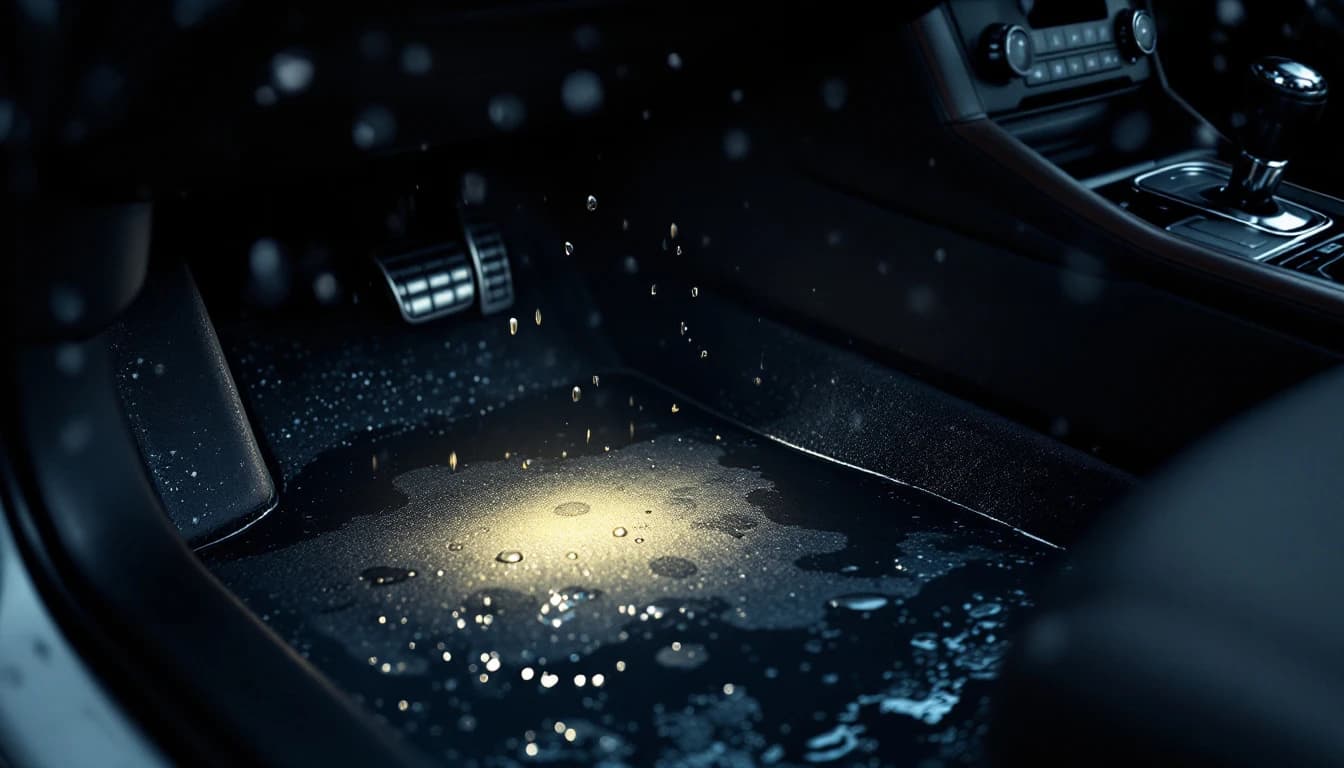
The air-conditioning evaporator drain. A plugged evaporator drain floods the passenger footwell with condensate, quietly, over weeks. The tell is a damp carpet with no rain in the forecast and a faint smell before any electrical symptom appears.
Trunk and taillight seals. Mercedes places significant electronics in the trunk area on many platforms, and a failed taillight gasket or a leaking trunk seal puts water into that space. Range Rover and Jaguar share the pattern. A trunk that smells damp and a key the car cannot find are more closely related than they look — our Jaguar BCM repair and smart key not found page covers that exact presentation.
Door membranes. The plastic vapour barrier behind a door card sheds water past the window regulator. A torn one soaks the door module and the connectors at the harness boot between door and body, which is also where the wiring flexes ten thousand times a year.
The symptom pattern that gives it away
A single failed module produces a coherent set of symptoms. Water produces an incoherent one. That difference is the fastest diagnostic tool available and it costs nothing.
Suspect water when you see:
- Faults that come and go with the weather — fine in a dry week, strange the morning after rain.
- Symptoms that share no electrical logic: interior lights and the fuel gauge, or key recognition and the rear wiper.
- Faults that improve as the day warms up and return overnight, because moisture is condensing rather than pooling.
- A carpet, spare-wheel well or trunk floor that is damp with no obvious source.
- A fuse that blows again immediately after replacement, which points at a shorted circuit rather than a tired component.
- Corrosion or green residue on a connector when something is finally opened up.
Contrast that with a straightforward module failure, which is usually consistent, present in every condition, and confined to functions that share a controller. Our page on BCM symptoms that get misdiagnosed as key problems covers that other pattern in detail.
Why water so often shows up as a key or start problem
Because the modules that authenticate the key are frequently the ones sitting in the water's path. The footwell, the scuttle and the trunk are exactly where manufacturers put body controllers, comfort modules and receivers, and those are the components that decide whether the car sees your key.
So the symptom an owner reports is "my key stopped working", the assumption is a dead fob, and two hundred dollars later there is a new key that does not solve anything. The key was never the problem. The antenna, receiver or body module that reads the key had corrosion on a connector pin.
This is why we ask about leaks and damp carpets on key-not-recognised calls, and why a diagnostic read comes before a key is written. Our page on key not detected and antenna ring faults covers the non-water versions of the same complaint.
The 2026 DFW cost table
Ranges reflect mobile pricing in the DFW service area as of August 2026 and match the bands published across our European module coverage. Water damage prices by what the water reached, not by what the symptom looked like — these are planning numbers, not quotes. Call (682) 344-1957 with your year, model and symptom for a firm figure before dispatch.
| Outcome | Mobile (DFW) | Typical dealer quote | When this is the outcome |
|---|---|---|---|
| Diagnostic read, fault pattern and module health | $90–$150 | $185–$295 | Always first; usually waived if you book the repair |
| BMW FRM bench repair (footwell module) | $250–$450 | Dealer replaces rather than repairs | Corrosion on a board that is otherwise sound |
| BMW FRM replacement + coding | $500–$800 | $700–$1,200 + tow | Board genuinely unrecoverable |
| Range Rover BCM coding, existing fobs (L405/L494) | $300–$500 | $600–$1,100 | Coding after a module is replaced |
| Component-protection coding only (Audi/VW) | $350–$550 | Handled in-house with a dealer part | Replacement module fitted, pairing missing |
| Audi ECU replacement + component-protection coding | $650–$1,100 | $1,300–$2,100 + tow | Controller destroyed rather than corroded |
| Mercedes EIS module replacement + key re-pairing | $1,200–$1,800 | $2,500–$4,000 + tow | The classic water-damage outcome on an EIS |
| Flatbed, when the car cannot be driven | — | $150–$300 | Avoided entirely by mobile service |
How the diagnosis is actually done
Establish the fault pattern first. Which functions fail, under what conditions, and do they share a controller? Incoherent groupings point at wiring and water. Coherent ones point at a module.
Find the water before touching electronics. Lift the carpet at all four footwells and press. Open the trunk, lift the floor, check the spare well. Pull the scuttle trim and look at the drains. Damp underlay with a dry carpet surface is common and easy to miss.
Prove the drains. A litre of water poured into a sunroof channel should appear under the car in seconds. If it does not, the tube is blocked, and that is the actual repair.
Read the modules. Communication faults and implausible stored values across several unrelated modules corroborate a wiring or moisture problem. A clean network with one module reporting internal faults points somewhere much more specific.
Inspect connectors. Green residue, white powder or a pin that has lost its shine is confirmation. Corrosion inside a connector produces resistance, resistance produces voltage drop, and a module receiving nine volts instead of twelve behaves erratically without ever failing outright.
Only then decide repair versus replacement. A board with surface corrosion and healthy traces is frequently repairable at bench level. A board with lifted traces or a failed processor is not. Making that call correctly is worth several hundred dollars to the owner, and it is the reason a shop that only replaces parts will always quote the higher number. Our guide to flash, clone, code and adapt explains why a replacement module is never simply a plug-in swap on these platforms.
What to do in the first 48 hours
If you suspect water and the car is still driveable:
- Dry the interior aggressively. Lift the carpet, run a fan, use a dehumidifier in a closed garage if you have one. Water that leaves before it sits does far less damage.
- Do not keep cycling the ignition to see whether the fault has cleared. Every attempt with a compromised circuit is another chance to blow something that was only marginal.
- Photograph everything — damp carpet, water lines, corrosion. If an insurance claim follows a storm, that evidence has value.
- Clear the drains if you can safely reach them. This is the cheapest repair in the entire article.
- Get the fault pattern read before parts are bought. Replacing a module into a wet car is buying the same failure twice.
When to call, and what we need
Call when faults are intermittent and unrelated, when a fuse blows repeatedly, when the key stops being recognised after wet weather, or when you have found damp carpet and want to know what is underneath it before it gets worse.
On the phone: year, model and engine; which functions misbehave and when; whether you have found water, and where; and whether any module has already been replaced. Response inside Arlington city limits typically runs 12–22 minutes, Dallas 25–45, and diagnosis happens where the car sits. If the trail leads to an engine controller rather than a body module, our ECM replacement cost, mobile versus dealer page covers that branch, and our overview of ECM, BCM and TCM programming explains which controller does what.
If you are still choosing a shop, our guide to BCM programming near me and how to vet a module shop covers the questions that separate a real local specialist from a dispatch broker. Locksmith companies in Texas are regulated by the Texas Department of Public Safety Private Security Program under Occupations Code Chapter 1702 — not TDLR. Not Your Basic Locksmith operates under Texas DPS certificate #B28531501, from 1168 W Pioneer Parkway in Arlington, with mobile service across the metro.
Frequently Asked Questions
Can water damage cause a car key to stop working?
Yes, and it is one of the most misdiagnosed versions of that complaint. The antenna, receiver and body module that read your key often sit in the footwell, scuttle or trunk — exactly where water collects. Corrosion on one connector pin is enough to stop the car recognising a perfectly good key, and a new key does nothing for it.
How do I know if my electrical problem is water damage?
The pattern gives it away. Water produces faults that come and go with the weather and that share no electrical logic — interior lights and the fuel gauge, or key recognition and the rear wiper. A failed module produces consistent faults confined to functions that share a controller. Damp carpet or a damp spare-wheel well turns the suspicion into a finding.
Where does water usually get into a European car?
Four places account for most of it: blocked sunroof drain tubes, blocked windshield cowl and scuttle drains, a plugged air-conditioning evaporator drain, and failed trunk or taillight seals. Torn door vapour barriers are a fifth. All five are maintenance items rather than defects, and all five are cheaper to clear than to ignore.
Can a water-damaged module be repaired instead of replaced?
Often, yes, if it is caught early. A board with surface corrosion and intact traces can be cleaned and repaired at bench level — a BMW FRM in that state is a $250–$450 job in DFW as of August 2026 against $500–$800 for replacement and coding. A board with lifted traces or a failed processor has to be replaced.
Will replacing the module fix the problem?
Only if the leak is fixed first. A replacement module fitted into a car that is still taking on water will fail again, usually within months, and the second failure is nobody's warranty claim. The leak is the repair; the module is the consequence.
Is water damage covered by insurance?
It depends on the policy and the cause. Storm and flood damage is frequently covered under comprehensive terms; a drain that was never maintained is usually treated as wear. Photograph the damp areas, corrosion and any water line before anything is dried or dismantled, and let the adjuster make the call with evidence in front of them.
How much does water damage diagnosis cost in DFW?
A diagnostic read that establishes the fault pattern and module health runs $90–$150 as of August 2026, and it is usually credited against the repair if you book it. That step is what prevents the far more expensive mistake of buying a module before anyone has found the leak.
My car was in a flood. Is it worth repairing?
Ask how high the water went before you ask anything else. Water below the carpet is usually recoverable. Water above the seat cushions means it reached the harness, the connectors under the seats and often the modules mounted there, and the honest answer at that point is that repair costs become unpredictable. A diagnostic read tells you which situation you are in before you commit money to either path.