Identify Your Car Key First: FCC ID, Chip Type and Blade Profile
As of August 2026, the single most expensive mistake a DFW driver makes on car keys costs about $35 and arrives in a padded envelope: a fob that fits the hand perfectly, matches the photo exactly, and cannot be programmed to their vehicle. Not because it was fake, and not always because it was cheap — because it was the wrong one.
Two vehicles built in the same year, with the same badge on the trunk, routinely take different keys. Trim level changes it. Build date changes it. The plant that assembled the car changes it. The only reliable way to know what your car takes is to read the identifiers, and every one of them is printed somewhere you can see in about five minutes.
Here is how to read them, and what each one tells you.
The four identifiers that matter
FCC ID. The Federal Communications Commission identifier for the radio transmitter inside the fob. It is printed on the back of the fob or moulded into the case, in a format like `M3N-A2C931426` or `OUC60270`. This is the most useful single string on the key, because it identifies the exact transmitter — frequency, modulation and rolling-code scheme all follow from it. Two fobs sharing an FCC ID are the same transmitter regardless of button layout.
IC number. The Canadian equivalent, usually printed next to the FCC ID. Harmless, sometimes useful for cross-referencing when the FCC ID has worn off.
Manufacturer part number. Often on the back or inside the case. Useful for ordering an exact OEM match, and the identifier a dealer parts counter will want.
Blade profile. The physical shape of the metal key or the emergency blade hidden inside a smart key. It has a name — HU100 on many GM products, HU101 on modern Ford, HU66 on VW and Audi, TOY44 on Toyota, HON66 on Honda, VA2 on some European platforms. The blade determines what the key can be cut on, which is entirely separate from what the fob can talk to.
You do not need to know all of these to get a key made. You need to know that a shop asking for them is doing its job, and that a seller who does not ask for any of them is selling you a lottery ticket.
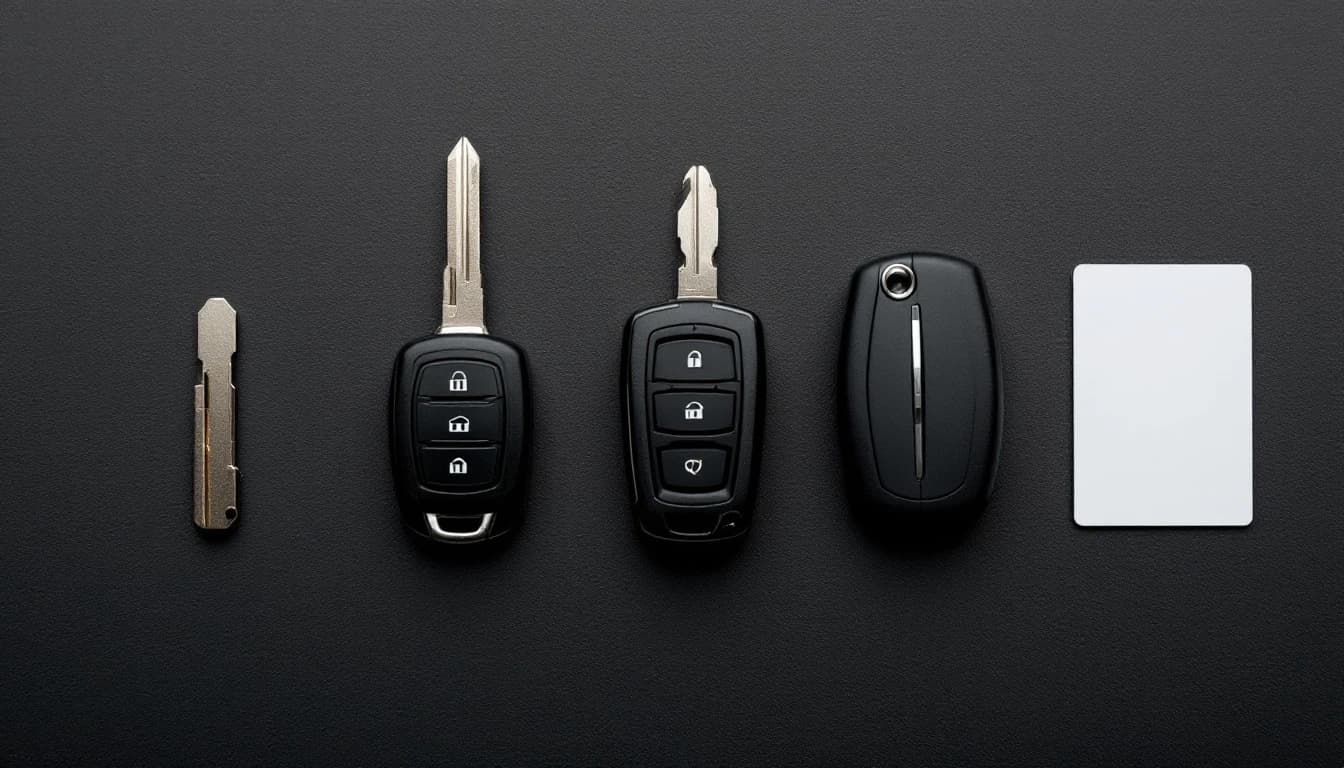
The five key types, and how to tell yours apart
| Key type | How to recognise it | What making one requires | Typical DFW spare cost |
|---|---|---|---|
| Mechanical key | Plain metal, no plastic head electronics, no buttons | Cutting only | Lowest — cutting only |
| Transponder key | Plastic head, no buttons, chip embedded in the head | Cut + programme the chip | $150–$250 domestic and Japanese |
| Remote head key | Plastic head with buttons, blade fixed or flip-out | Cut + programme chip and remote | $150–$300 depending on platform |
| Smart / proximity key | No blade in normal use, push-button start, hidden emergency blade | Programme to immobilizer; cut the hidden blade | $200–$400 mainstream, more on European |
| Key card / digital | Card or phone, no metal at all | Pairing rather than cutting | $150–$300 on Tesla-style systems |
The boundary that surprises people most is between a remote head key and a smart key. A remote head key has buttons and looks modern, but the car still needs the blade inserted and turned. A smart key stays in your pocket. If your car has a start button and you have never inserted the key, you have a smart key — and it will contain a small metal emergency blade you have probably never used, which is nonetheless part of the job when a replacement is made.
What the chip actually does
Inside a transponder or smart key is a small passive chip with no battery of its own. When you turn the ignition or press start, an antenna coil around the lock cylinder or in the console energises the chip, the chip answers with a cryptographic response, and the immobilizer decides whether to allow fuel and spark.
Chip families are the reason keys are not interchangeable even when they fit.
Fixed-code chips were the early generation. They answer with a static value. They are simple, cheap and long since superseded on anything current.
Crypto chips — the Texas Instruments 4D and G/H families common on Toyota and Lexus, the NXP ID46 family found across an enormous range of makes, and the newer ID47 and ID49 generations — perform a challenge-and-response calculation. The immobilizer sends a random challenge, the chip computes an answer using a secret it never transmits, and only the right chip produces the right result.
This matters practically in one way. A key blank sold as "universal" is universal in shape only. The chip inside it either belongs to the family your immobilizer speaks to or it does not, and no amount of programming skill bridges that gap. It is the most common reason a shop looks at a fob an owner brought and says, kindly, that it will never work in this car.
Toyota's G and H chip transition is the classic example of a change invisible from outside the key, and it is one of the reasons Toyota key fob programming is platform-specific rather than one procedure.
Frequency, and why your fob might work but not start the car
The radio side and the immobilizer side are separate systems that happen to live in the same plastic case.
The remote — lock, unlock, panic, remote start — transmits on a radio frequency, usually 315 MHz on North American vehicles and 433 MHz on many European ones. That is a one-way broadcast to a receiver in the car.
The transponder is a short-range, low-frequency exchange that only happens within a few centimetres of the antenna coil, and it is what actually authorises the engine.
Because they are independent, you get failure modes that look contradictory. A fob that locks and unlocks but will not start the car has a working remote and an unrecognised transponder. A key that starts the car but will not lock the doors has the opposite. And a fob with a flat battery still starts many vehicles, because the transponder needs no battery — which is exactly why manufacturers tell you to hold a dead smart key against the start button.
VW and Audi owners see this split more than most, and the symptom map is worth reading before you replace anything: troubleshooting Volkswagen key fob issues walks through which failure points to which component.
The five-minute check before you buy anything
1. Photograph the back of your existing key. FCC ID, IC number, part number. If the print has worn away, open the case carefully and look inside.
2. Photograph the blade if there is one — including the emergency blade inside a smart key. Note whether the cuts are on the edges (traditional) or milled into the flat face (high-security laser cut).
3. Note your exact build details. Year, make, model, trim. Then find the build date on the driver's door jamb sticker. Mid-year platform changes are real and the door sticker is what settles them.
4. Check the VIN. Visible through the windshield on the driver's side. Any competent shop can decode the correct key from it, and it is the identifier that overrides everyone's assumptions.
5. Count your working keys. One working key means adding a spare. Zero means all-keys-lost, a different job at a different price.
Those five items answer every question a shop needs to ask, and they turn a twenty-minute phone conversation into a two-minute one.
Where identification gets genuinely hard
Some platforms cannot be identified from the key at all.
European vehicles with component protection. On newer Audi and VW models, and across Mercedes and BMW generations, the key is not a standalone part — it is paired to specific modules in the car, and a key from an identical vehicle will not work in yours. This is why Mercedes key replacement cost sits in its own band on every price list, and why the BMW chassis-code key system decoder is organised by platform generation rather than by model name.
Vehicles where the key was already replaced once. If a previous owner had an aftermarket fob programmed, the key in your hand may not match what the vehicle originally shipped with. The VIN still tells the truth; the key no longer does.
Late-generation smart systems. On the newest platforms, key identification is a lookup against the vehicle's configuration rather than a part-number match, and it needs authenticated access to perform — the subject of our guide to security gateways on newer vehicles.
In all three cases the answer is the same and it is not a disappointment: send the VIN and a photo of the existing key to someone who can decode it properly, before ordering anything. Identification is free. A wrong fob is not.
Frequently Asked Questions
Where is the FCC ID on a key fob?
Printed on the back of the fob or moulded into the plastic case, usually in a format like `M3N-A2C931426` or `OUC60270`, often alongside an IC number. If the print has worn off, it is frequently repeated on the circuit board inside the case. The FCC ID identifies the exact radio transmitter, so two fobs sharing one are the same transmitter regardless of how the buttons are arranged.
Can I buy a key fob online and have a locksmith program it?
Often yes, and it is a legitimate way to save money — provided the fob is genuinely correct for your vehicle and is a quality unit. The two failure modes are ordering the wrong FCC ID or chip family, which no programming can fix, and buying a poor-quality clone that programmes and then fails within months. Send your VIN and a photo of your existing key to the shop before you order, and ask whether they will programme a customer-supplied fob at all — many will, some decline for warranty reasons.
What is the difference between a transponder key and a smart key?
A transponder key has a chip in its plastic head and must be physically inserted and turned; the chip authorises the engine while the blade operates the cylinder. A smart key stays in your pocket, communicates with the car by proximity, and is used with a push-button start. Smart keys contain a hidden emergency blade for the door, which is still cut as part of a replacement even though you may never use it.
Why won't a fob from an identical car work in mine?
Because most modern keys are cryptographically paired to your specific vehicle rather than being a generic part. Even when the FCC ID and chip family match, the key must be written into your immobilizer's key table. On European platforms with component protection the pairing goes further, tying the key to specific modules, which is why a donor key from an identical model will not work regardless of programming.
Does my key fob still start the car if the battery is dead?
On most vehicles, yes. The transponder chip that authorises the engine is passive and draws its power from the antenna coil in the car, so it works with no battery at all. The battery only powers the radio side — lock, unlock, remote start, and the proximity detection that lets you keep the key in your pocket. That is why manufacturers instruct you to hold a dead smart key against the start button or a marked spot on the column.
How do I know if my key is high-security laser cut?
Look at the blade. A traditional key has cuts on the edges; a high-security or laser-cut key has a track milled into the flat faces of the blade, often in a wavy sinusoidal pattern, with the edges left smooth. Laser-cut blanks need a milling machine rather than a standard duplicator, which is one of the reasons those keys cost more and why not every shop can cut them.
What information should I give a locksmith over the phone?
Year, make, model and trim; the VIN if you can read it through the windshield; the FCC ID from your existing key if you have one; whether you have a working key or none at all; and whether your car has a push-button start. Those answers determine the blank, the programming procedure, the price and how long the job takes, which means most quotes can be given accurately before anyone is dispatched.
Can the same key work for the ignition and the doors?
On the overwhelming majority of vehicles, yes — one key operates everything. The exception is older vehicles where a valet key was supplied that opens the doors and ignition but not the glovebox or trunk, and cases where a lock cylinder was replaced at some point and never rekeyed to match the original. If your current key works in the doors but not the ignition, that is a lock or ignition fault rather than a key identification issue.
Send a photo, get a straight answer
Not Your Basic Locksmith identifies, cuts and programmes keys for every major make across the DFW metroplex — Arlington, Fort Worth, Dallas, Grand Prairie, Mansfield, Irving and the surrounding cities — including high-security laser-cut blades and proximity smart keys, at your vehicle.
Call or text (682) 344-1957 with your year, make and model, a photo of the back of your existing key, and whether the car has a push-button start. We will tell you exactly which key your vehicle takes, what it costs, and how long it takes — before anything is ordered. Owner-operated, ALOA Master Automotive Locksmith credentialed, based at 1168 W Pioneer Parkway in Arlington. Texas DPS certificate #B28531501.