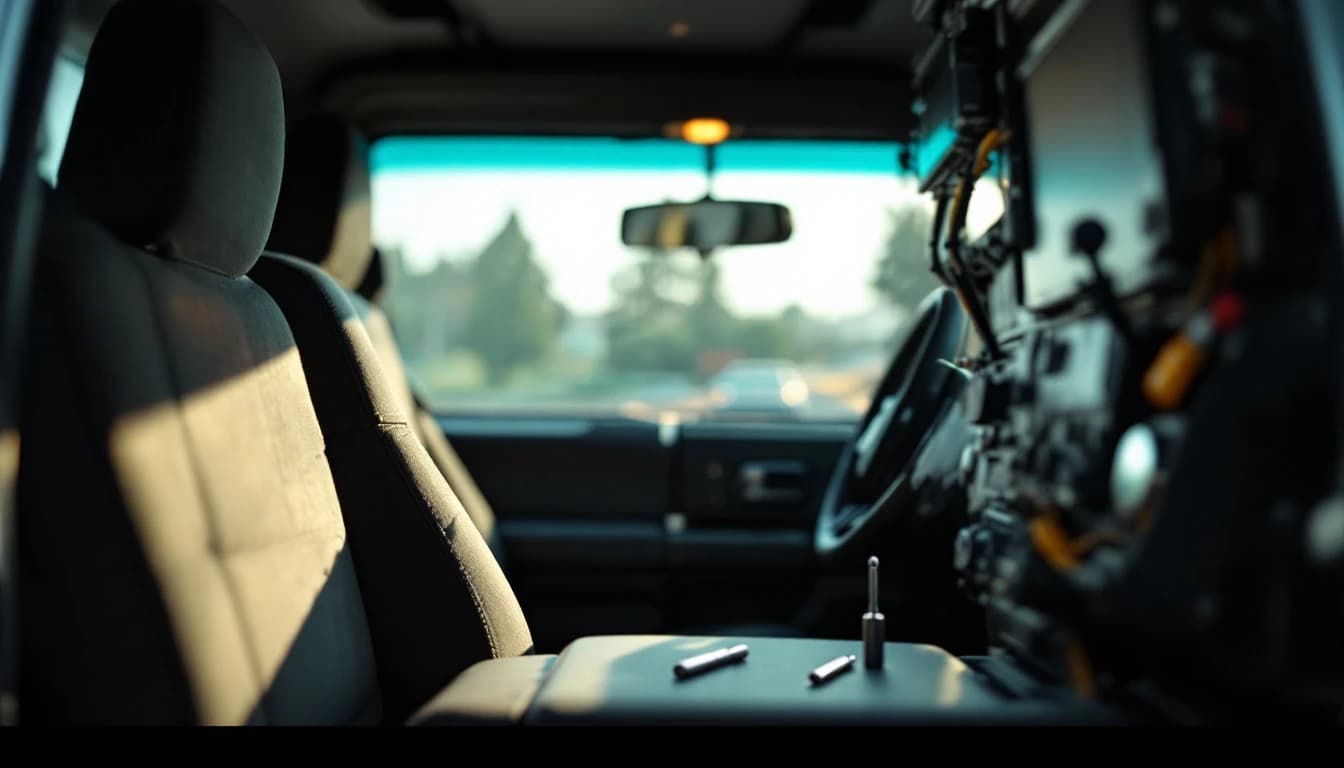
Chevy and GMC Column Work: The PassLock Relearn Nobody Warns You About
As of August 2026, the most common "the locksmith broke my truck" call we take on GM products is not a broken truck at all. It is a correctly replaced ignition lock cylinder on a PassLock-equipped Silverado, Sierra, Tahoe or Suburban, followed by a security light and an engine that cranks strongly and will not fire — because the body control module is still expecting the electrical signature of the old part and nobody performed the relearn.
The relearn takes about thirty minutes and needs no tools at all. Knowing it exists is the whole trick, and it is why the same column job goes smoothly at one shop and ends in a tow at another.
GM has used three distinct anti-theft schemes across the vehicles still on DFW roads, and they fail in visibly different ways. Identifying which one your vehicle has is the first step in every diagnosis.
The three GM systems
VATS / PassKey (roughly 1986–2005). The oldest approach, and mechanically the simplest. A small resistor pellet is embedded in the blade of the key itself, and contacts inside the lock cylinder read its resistance value when the key is inserted. Right value, the car starts. Wrong value or no reading, it does not. The classic failure is not the key at all — it is the thin wiring harness running from the cylinder down through the column, which flexes every time the wheel turns and eventually breaks a conductor.
PassLock I and II (roughly 1995–2007). The resistor moves out of the key and into the lock housing itself, as a sensor that reports a fixed value to the body control module when the cylinder is rotated. The key becomes a plain mechanical key with no electronics. This is the system that requires a relearn, because the body module memorises the specific value of the sensor fitted to that vehicle.
PassKey III and later transponder systems (roughly 2000 onward). A conventional transponder chip in the key head, read by an antenna around the cylinder — the same architecture the rest of the industry uses. On later Global A and Global B platforms it evolves into full immobilizer integration with the engine control module.
Model years overlap heavily and GM mixed systems across platforms in the same calendar year, so the year alone does not settle it. The reliable check is the key: electronics in the key head means a transponder system, a small dark pellet visible in the blade means VATS, and a plain key with no electronics anywhere on a vehicle with a security light means PassLock.
Why replacing the cylinder stops the truck starting
On PassLock the sequence is deterministic and catches people out every time.
The body control module has learned a specific resistance value from the sensor in the original lock housing. Replace that housing and the new sensor's value differs — within manufacturing tolerance, but not identical. The module sees a value it does not recognise, concludes that somebody is defeating the lock, illuminates the security light, and disables fuel injection.
The engine cranks perfectly. All the electrics work. Nothing is broken. The vehicle is doing precisely what it was designed to do.
The fix is the thirty-minute relearn: turn the key to the on position so the engine attempts to start and fails, then leave the key at on with the security light illuminated for ten minutes until it goes out, cycle the key off for a few seconds, and repeat the cycle three times. On the third cycle the module accepts the new value and the vehicle starts normally. Some GM platforms need only a single ten-minute cycle; others want all three. It requires a healthy battery — a marginal one drops voltage during the wait and the procedure fails silently, which is the most common reason a relearn "does not work".
That procedure is also worth knowing for a completely different situation: a PassLock vehicle that has been sitting on a flat battery, or has just had one replaced, occasionally loses the stored value on its own and presents identically. Same symptom, same fix, no parts.
What each fault costs to put right
| Symptom | System | Likely cause | Typical DFW range |
|---|---|---|---|
| Security light, no start, after column work | PassLock | Relearn not performed | Relearn only — no parts |
| Intermittent no-start, wiggling the harness changes it | VATS | Column harness conductor broken | $150–$350 |
| Security light after a flat battery | PassLock | Lost stored value | Relearn only — no parts |
| Key turns hard or sticks | Any | Worn key or worn cylinder | $150–$350 |
| Cranks, security light, spare key works | PassKey III | Failed transponder in key | $150–$250 |
| Cranks, security light, neither key works | PassKey III | Antenna, wiring or module | $200–$450 |
| Key snapped in the cylinder | Any | Extraction plus new key | $150–$300 |
For the specific case of a key that has broken off inside the lock, the extraction procedure and what it does to the cylinder is covered in our guide to a key breaking inside a Chevrolet ignition.
When the answer is a bypass — and when it is not
GM's older systems are among the few where a legitimate bypass is sometimes the right engineering answer. On a high-mileage VATS-equipped vehicle whose column harness has failed for the third time, and where the original components are no longer available, a properly executed VATS bypass restores reliable starting without leaving the vehicle in a compromised state.
That is a narrow case with clear conditions attached. It applies to genuinely obsolete systems on older vehicles with a documented repeated failure, with the owner's informed consent, and never as a shortcut around diagnosing a repairable fault. On any modern GM platform where the immobilizer is integrated with the engine module, it is neither practical nor advisable — the correct path is repair or module programming, and our guide to which car modules need the dealer and which don't sets out where that line falls.
If a shop offers to disable the anti-theft system on a late-model truck as a first response rather than a last resort, that is a signal about the shop rather than about your vehicle.
Keys, fobs and the relearn's cousin
Column work and key work overlap constantly on these trucks, because the same visit often produces both. A replacement cylinder means new mechanical keys; a truck with a transponder system means those keys also need programming; and a keyless entry fob that stopped working somewhere along the way is worth sorting in the same session rather than on a second call.
The programming side for GM trucks is covered in our GMC Sierra key fob programming guide, which walks through what can be done at the vehicle and what the newer platforms require. For Chevrolet specifically, Chevy key fob programming covers the same ground on that side of the badge. And if your truck is on a Global B platform — broadly 2019 and newer — key and module writes pass through the manufacturer's authentication gate, the subject of our guide to security gateways on newer vehicles.
Habits that save the next cylinder
GM trucks wear ignitions for the same reason Ford trucks do: cycles and load. Two things extend the life of the repair.
Reduce the keyring. A heavy ring hanging from the cylinder side-loads the wafers and the sensor housing on every bump. On a work truck over a Texas summer that is a measurable amount of wear.
Replace a sticky key early. A worn key accelerates wear inside the lock and, on PassLock vehicles, forces the cylinder to be turned harder, which loads the sensor assembly the module depends on. A $180 key replaced on time avoids a $350 cylinder job later.
And if the truck currently starts on only one key, get a second one made while that key still works. A spare is the cheapest key you will ever buy, as our spare key cost guide sets out — the price roughly doubles or triples the moment the last working key is gone.
Frequently Asked Questions
What is a PassLock relearn and when is it needed?
It is a thirty-minute procedure that teaches the body control module the electrical value of a newly fitted ignition lock housing. It is required after replacing the lock cylinder or housing on a PassLock-equipped GM vehicle, and occasionally after a flat battery causes the stored value to be lost. Without it the vehicle cranks strongly and will not start, with the security light illuminated — the module is rejecting an unfamiliar sensor value, not reporting a broken part.
How do I perform the GM 30-minute relearn?
Turn the key to the on position so the engine attempts to start and fails, then leave it at on with the security light illuminated for ten minutes until the light goes out. Turn the key off for a few seconds, then repeat. Some platforms accept the new value after one cycle; others need all three. A healthy battery is essential — a weak one sags during the wait and the procedure fails silently, which is the usual reason a relearn appears not to work.
Which GM anti-theft system does my truck have?
Look at the key. A small dark resistor pellet visible in the metal blade means VATS or PassKey, used roughly from 1986 to 2005. Visible electronics in the plastic head means a transponder system, PassKey III or later, roughly 2000 onward. A completely plain mechanical key on a vehicle that has a security light means PassLock, roughly 1995 to 2007. Model years overlap, so the key is a more reliable indicator than the year.
Why does my Silverado start sometimes and not others?
On VATS-equipped vehicles the leading cause is a broken conductor in the thin harness that runs from the ignition lock down through the steering column. It flexes every time the wheel turns and eventually fails intermittently. The diagnostic tell is that the fault correlates with steering position or with bumps. Owners frequently replace keys, ignition switches and fuel components before someone checks those two wires.
Can the security light be turned off without fixing the cause?
Not meaningfully, and it should not be. The light is the system reporting that it has disabled the engine deliberately. On PassLock, the correct response to a light after column work is the relearn; after a flat battery, the same. On transponder systems it is a key, antenna or module diagnosis. Suppressing the indicator would leave you with a vehicle that still refuses to start and no longer tells you why.
Is a VATS bypass legal and is it a good idea?
Bypassing an obsolete anti-theft system on an older vehicle is legitimate work with the owner's consent, and on a high-mileage VATS vehicle with repeated harness failures and no available original parts it is sometimes the sensible engineering answer. It is not appropriate as a first response, as a way to avoid diagnosis, or on any modern platform where the immobilizer is integrated with the engine control module. A shop that opens with a bypass rather than a diagnosis is telling you something about itself.
Does replacing the ignition cylinder mean I need new keys?
Usually you have a choice. A replacement cylinder can be keyed to match the key you already carry, so one key continues to operate the doors and ignition. The alternative gives the cylinder its own new key, leaving you with two. Ask for the matched option up front — it is straightforward at the time of fitting and awkward afterwards.
Can this work be done at my location?
Yes for the great majority of it. Cylinder replacement, relearn procedures, column harness diagnosis, key cutting and programming are all done at the vehicle, which matters because a truck that will not start or steer is expensive to tow. Confirm when you call, but mobile repair is the normal path for all of the faults described here.
The relearn is free — knowing about it is the job
Not Your Basic Locksmith works on GM ignition columns, PassLock relearns, VATS harness faults and transponder key programming across the DFW metroplex — Arlington, Fort Worth, Dallas, Grand Prairie, Mansfield, Irving and the surrounding cities — at the vehicle.
Call or text (682) 344-1957 and tell us the model and year, whether your key has electronics in the head or a pellet in the blade, whether the security light is on, and whether the engine cranks. That is normally enough to name the system and the fault before anyone is dispatched. Owner-operated, ALOA Master Automotive Locksmith credentialed, based at 1168 W Pioneer Parkway in Arlington. Texas DPS certificate #B28531501.