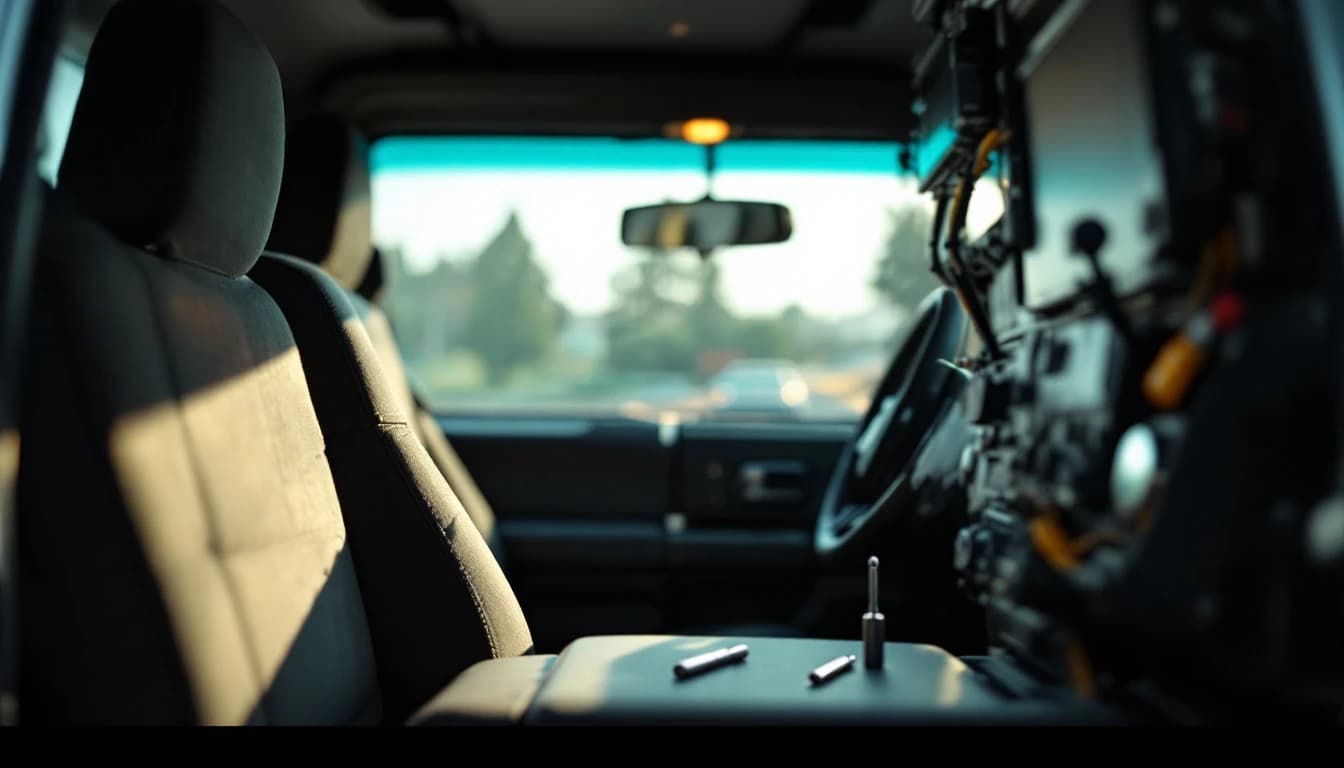
Audi Steering Lock Failure on the A4, A5 and Q5
If your B8-generation Audi A4, A5 or Q5 lit up its dash, showed a steering lock malfunction message and refused to start — or the steering wheel stayed locked when you pushed the key in — the most likely culprit is the electronic steering column lock, known in Audi documentation as the ELV. It is a small motorised lock on the steering column that has to confirm it has released before the car will allow the engine to start. When it fails, the car behaves exactly as if the key were bad, which is why so many owners buy a key first.
As of September 2026 in Dallas–Fort Worth, getting to the answer costs a diagnostic read of $90–$150, against $185–$295 at a dealer, usually credited when you book the repair. The repair itself is quoted by VIN after that read, because the steering lock on these cars participates in the immobilizer and the right route depends on the exact build. What we can tell you in general terms is that the specialist route avoids the dealer's flatbed — $150–$300 in this metro — because a car with a failed column lock cannot be driven to them.
This page covers what fails, how to recognise it from the driver's seat, the checks worth doing before you call anyone, and the repair routes, with their honest trade-offs.
Which Audis this affects
The column lock problem concentrates on the B8 generation and its relatives:
| Model | Generation | US model years (approx.) | Start system |
|---|---|---|---|
| A4 sedan and Avant / allroad | B8 / B8.5 | 2009–2016 | Key inserted into the dash slot and pressed, or Advanced Key |
| S4 | B8 / B8.5 | 2010–2016 | Same architecture as the A4 |
| A5 coupe, cabriolet and Sportback | 8T | 2008–2017 | Same architecture as the A4 |
| S5 / RS5 | 8T | 2008–2017 | Same architecture |
| Q5 / SQ5 | 8R | 2009–2017 | Same architecture |
Why the column lock stops the car
When you switch the car off, the ELV drives a locking bolt into the steering column. When you present a valid key, the car's entry and start module asks the lock to release, and the lock reports back that it has. Only then is the start authorised.
The failure is mechanical wear and electronic ageing in a part that works every single time the car is started and stopped. The motor weakens, the locking bolt sticks, or the lock's own control electronics stop answering. The car never receives the "released" confirmation, logs a fault, and refuses to start. The key was accepted; the lock is what failed.
Texas heat is not kind to it. In our experience the failure tends to announce itself in hot weather, when the column is soaked in cabin heat and a weakening motor finally cannot finish its travel.
The symptoms, early and late
Early warning signs
- The steering wheel takes a moment longer to release, sometimes with a buzz or click from the column.
- Occasionally the car needs a second attempt, or a wiggle of the wheel, before it starts.
- A steering lock message appears briefly and clears itself.
When it has failed
- The key goes in (or the Advanced Key is in the car), the dash lights up, and the engine will not crank.
- The steering wheel stays locked, or the column motor clicks without releasing.
- A steering lock malfunction message appears on the instrument cluster, often telling you to contact a workshop.
- The problem is the same with every key you own.
That last point is the most useful single clue. Keys fail one at a time. When every key produces the same no-start and the same message, the car is the problem, not the keys.
Checks worth doing before you call
Five minutes in the driveway can separate a column lock from something cheaper.
- Try every key. If one key starts the car and another does not, you have a key problem, and this page is not your page.
- Turn the wheel gently both ways while starting. Pressure on the locking bolt can stop a weak motor from releasing it. Taking the load off sometimes lets it through — and if it does, that tells you the lock is on its way out.
- Look at the dash when you press start. If the instruments dim heavily or flicker, the battery is the likely suspect. A tired battery produces convincing imitations of a steering lock fault. Charge or test it before anything else.
- Note the exact message. Word for word, or a photo of the cluster. It narrows the diagnosis before anyone arrives.
- Think about what changed. Battery replacement, a jump start, or a recent repair that involved the steering column or the dash changes the picture.
If every key fails, the battery is healthy and the message names the steering lock, stop repeating start attempts. They will not fix a seized lock and they drain the battery you are going to need.
What else can look like a steering lock fault
| What you see | More likely cause | What to do |
|---|---|---|
| Heavy dimming at start, then nothing | Weak or failing car battery | Charge or test the battery first |
| One key starts the car, the other does not | The failing key | Key repair or a replacement key |
| Starts, then stalls a second later | Immobilizer or engine-controller fault | Diagnostic read of the immobilizer chain |
| Advanced Key not detected, wheel turns freely | Key battery, antenna or entry module | Emergency start procedure, then diagnosis |
| Steering locked, lock message, every key the same | Electronic steering column lock | Diagnosis, then the ELV repair route |
The repair routes
Once the read confirms the steering lock, there are three ways forward.
Replacement lock, adapted to the car
A new steering lock goes in and is adapted to the car's immobilizer, because on this platform the lock is a participant in the security system rather than an independent part. The car keeps a working mechanical column lock, exactly as it left the factory. The adaptation step is what separates this from simply bolting in a part: a lock that has not been introduced to the car will not be accepted, however new it is.
Emulator in place of the lock
An emulator is a small electronic unit that answers the car's start module exactly as a healthy lock would. The mechanical column lock no longer engages, so the failure mode is gone for good. The immobilizer is untouched — the car still requires a correctly paired key to start — but the wheel no longer locks when the car is off. Some owners and some insurers prefer to keep the physical lock; we explain the choice before we start and leave it with you.
Dealer replacement
The dealer orders the lock, fits it and completes the adaptation through the factory's online systems. It is a clean result with factory parts. It is also the most expensive route, it begins with a tow for a car that cannot be driven, and parts availability decides how long the car sits.
The route to avoid: a used lock from a salvage car fitted without adaptation. It carries its original car's data, the start module will not accept it, and the owner ends up paying for the adaptation anyway, plus the part.
Why the price is quoted by VIN
We publish price ranges for most of our work — see the European module programming cost pillar and the Audi key replacement cost page. The Audi column lock is one job where we deliberately do not print a single band, for two reasons.
First, the adaptation path differs by build and model year within this generation, and the difference is large enough that an average would mislead half the people reading it. Second, the route you choose — replacement lock or emulator — changes the parts line. We would rather give you a firm number for your car on the phone, from the VIN, than a range that turns into a different number on arrival.
What you can hold us to: the diagnostic read is $90–$150 and is credited when you book, the repair is quoted in writing before any work begins, and there is no tow in the mobile route.
What happens on the appointment
- Read the modules. The entry and start module and the steering lock fault memory together confirm whether the lock failed to release, and rule out the key, the battery and the engine controller.
- Confirm the route with you. Replacement lock or emulator, with the trade-offs explained and the price confirmed.
- Access the lock. The steering column trim comes off to reach the ELV.
- Fit and adapt. The replacement or emulator goes in and is introduced to the car's security system.
- Test every function. Start, stop, column lock behaviour where retained, and every key you own.
- Clear and re-read. Fault memory is cleared and re-read to confirm nothing else is waiting.
If you are down to one key, this visit is the cheapest moment to add a second. The immobilizer system is already open, and a spare written now costs far less than an all-keys-lost job later — the numbers are in the Audi immobilizer cost page linked above.
Why a new key never fixes this
This is worth saying plainly because it is the most common wasted purchase on these cars. The steering lock failure happens after the key has been accepted. A new key is accepted in exactly the same way and then stopped by exactly the same lock. We regularly meet B8 owners who have bought one or two keys online, had them programmed elsewhere, and still have a car that will not start. When the lock is sorted, every key works — including the ones that were never needed.
What we keep seeing, September 2026. Most of this month's Audi no-start calls in DFW were B8 A4s and Q5s with well over a hundred thousand miles, and the pattern was identical: a few weeks of hesitant starts in the heat, then a morning when the wheel would not release at all. In two of them the owner had already paid for a key. In one, a tired battery was producing the steering lock message on its own, and a charged battery was the entire fix — which is why we always check voltage before anything else.
Frequently Asked Questions
What causes the steering lock message on an Audi A4, A5 or Q5?
On B8-generation cars it is usually the electronic steering column lock failing to confirm that it has released. The motor wears, the locking bolt sticks, or the lock's electronics stop answering, and the car refuses to start. A weak car battery can produce the same message, so voltage is checked first.
Can I drive my Audi with a failing steering lock?
While it still releases, yes, but it will eventually fail to release and leave the car immobilised wherever it is parked. If you are seeing early warning signs — slow release, clicking, occasional second attempts — get it diagnosed before it strands you.
Will a new key fix an Audi steering lock problem?
No. The key is accepted before the steering lock fails to release, so a new key is stopped in exactly the same way. If every key produces the same no-start, the car is the problem, not the keys.
What is an Audi ELV emulator?
A small electronic unit that answers the car's start module as a healthy steering lock would. The mechanical column lock no longer engages, but the immobilizer is untouched and the car still needs a correctly paired key to start. The trade-off is the loss of the physical wheel lock.
How much does an Audi steering lock diagnosis cost in DFW?
As of September 2026, the diagnostic read is $90–$150 in Dallas–Fort Worth against $185–$295 at a dealer, and it is usually credited to the repair. The repair itself is quoted in writing by VIN, because the adaptation path varies across this generation.
Does the car need to be towed to the dealer?
Not with mobile service. Diagnosis, the lock replacement or emulator, and the adaptation are done at the car, which avoids the $150–$300 flatbed the dealer route usually starts with.
Are the newer Audi A4 and Q5 affected?
This page covers the B8-generation A4, S4, A5, S5 and the first-generation Q5. The newer B9 A4 and A5 and the second-generation Q5 use a different architecture, and a no-start on those cars needs a separate diagnosis.
Get the lock confirmed before you buy a part
If your A4, A5 or Q5 is showing a steering lock message and will not start, do not order a key or a used lock. Get the modules read first. Not Your Basic Locksmith has specialised in European key and module work since 2012 and is licensed by the Texas Department of Public Safety Private Security Program. Arlington shop or mobile across Dallas–Fort Worth, seven days a week — call (682) 344-1957 with your model, year and a photo of the dash message.