Mercedes-Benz Control Unit Glossary
Mercedes-Benz paperwork, forum posts and dealer estimates are full of three- and four-letter abbreviations, and the same fault can be described with three different ones depending on who is talking. An owner hears "your EIS is bad" at one shop, "it's the ESL" at another, and "you need an ECU" at a third — and all three can be describing the same no-start.
This glossary is a reference. It names each control unit that takes part in unlocking, authorising and starting a Mercedes, says in plain English what it does, lists the symptoms it produces when it fails, and points to the page on this site that covers it in depth. It is not a repair guide, and it does not quote prices of its own: the figures live on the cost pages linked from each entry, so there is one set of numbers rather than several.
As of October 2026. Module names and fitment vary by chassis and model year. Treat this as a map, and let the VIN settle the specifics for your car.
The starting chain in one paragraph
When you start a Mercedes, several units agree in sequence. The key proves who it is to the ignition module (EIS or EZS). The ignition module, on many cars, tells the steering lock (ESL or ELV) to release. It also authorises the engine control unit (ME or MED) to run. A body module (SAM) manages the lights, locks and many comfort functions, and the instrument cluster shows the result to you. If any link disagrees, the car refuses to start, and the dash message is often the same whichever link is at fault. That is why diagnosis matters more than guessing.
The glossary
| Abbreviation | Stands for | What it does | What failure looks like |
|---|---|---|---|
| EIS / EZS | Electronic Ignition Switch (Elektronisches Zündschloss) | Holds the key table, checks the key at every start, authorises the engine | Intermittent no-start, "Start Error" message, key slot wear, keys not recognised |
| ESL / ELV | Electronic Steering Lock (Elektrische Lenkradverriegelung) | A motor-driven pin that locks the steering column when parked | Steering wheel stays locked, key will not turn, steering-lock message |
| FBS | Drive Authorisation System (Fahrberechtigungssystem) | The security generation: FBS3 on older cars, FBS4 on newer | Not a part; determines which procedures apply to a key job |
| Keyless-Go | Mercedes proximity entry and start | Lets the car detect the key without it leaving your pocket | "Key not detected", intermittent entry or start, antenna faults |
| SAM | Signal Acquisition and Actuation Module | A body module, often front and rear, that handles lighting, locks, wipers and related functions | Lights, wipers or locks misbehaving together; water damage in a footwell or trunk |
| ME / MED | Engine control unit families (for example ME9.7, MED17.7) | Runs the engine; part of the immobiliser handshake | No-start, limp mode, no communication with the engine controller |
| Instrument cluster | The dash display and its processor | Shows messages, mileage and warnings; on some cars takes part in security | Wrong or missing messages, dead gauges, odd mileage |
| ABS / ESP | Brake and stability control unit | Wheel-speed and stability functions | Warning lights, stability messages, not usually a no-start |
| SRS | Airbag control unit | Crash sensing and restraint deployment | Airbag light; module may hold crash data |
EIS and EZS: the ignition module
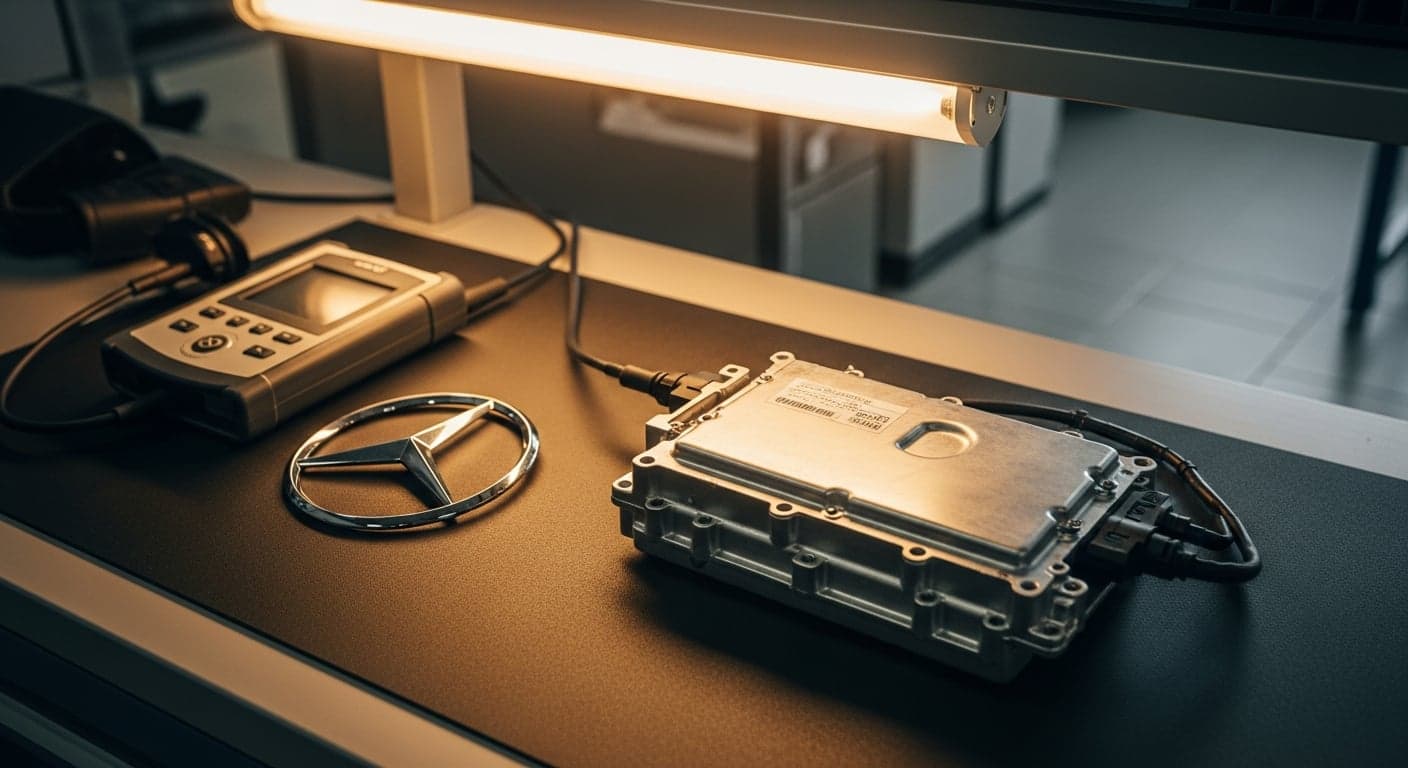
The EIS (called EZS in German documentation) is the unit most worth understanding, because it is where the key lives. Each key's identity is stored in the module's key table. At every start, the module runs a challenge and response with the key, and only then does it authorise the engine.
Because it holds the key table, the EIS is the centre of both key work and many no-start diagnoses. Adding a key means writing to it. A worn or corrupted EIS makes healthy keys look dead. Water damage, age and heat all take their toll, and the failure is often intermittent before it is total.
Where to read more: how keys are generated and priced is in our Mercedes-Benz key replacement cost guide; the module's own repair-versus-replace decision is in Mercedes EIS and EZS repair versus replacement cost.
ESL and ELV: the steering lock
The ESL (or ELV in German terms) is a small electromechanical assembly with a motor, a pin and a control board. When you park, the pin engages and locks the column; when you start, the ignition module commands it to release.
It is a wear item. On the W204 C-Class it is the single most common Mercedes no-start we hear about: the motor weakens, the pin sticks, and the car behaves as though the key has stopped working. The tell is a steering wheel that will not move and a steering-lock message. It is often repaired rather than replaced, and the repaired lock has to be re-matched to the ignition module afterwards.
Where to read more: the repair routes and what an invoice should show are in Mercedes steering lock repair cost, and the failure patterns by chassis in who fixes Mercedes ESL and EIS in Dallas.
FBS3 and FBS4: the security generations
FBS is not a part you can buy. It names the generation of the security system, and the generation decides what a specialist can do. FBS3 is the older generation, covering roughly through 2014, and is serviceable end to end by an equipped independent. FBS4 is newer, from roughly 2015 onward, and its all-keys-lost procedures depend on the chassis and year.
If your key slots into the dashboard and turns, you are very likely on FBS3. If the car has no slot and starts from a button with the key in your pocket, you are probably on FBS4. It is not a perfect rule, which is why the chassis map exists. Our Mercedes-Benz chassis code key system decoder assigns every common chassis to its generation.
Keyless-Go: proximity entry and start
Keyless-Go lets the car sense the key without you using it. It relies on antennas around the car and inside the cabin, and on a receiver that listens for the key's reply. The key still carries its own authorisation chip, so the system is two systems: proximity detection for entry and presence, and the security handshake for starting.
Faults in the antennas, the receiver or the key's battery all produce "key not detected" messages that feel like a dead key. Our guide to key not detected: antenna ring and coil faults separates them, and the BMW and Mercedes comparison in Comfort Access and Keyless-Go not working shows how the two brands present.
SAM: the body modules
Many Mercedes models of the 2000s and 2010s use one or more signal acquisition and actuation modules to manage lighting, locks, wipers and a long list of comfort functions. They are usually mounted low — a front unit in the engine bay or fuse area, and a rear unit in the trunk or under a seat — which is exactly where water gets in.
A failing SAM rarely stops the car on its own. It produces a cluster of odd faults: lights that flicker, wipers that run on their own, locks that do not respond, a battery that goes flat overnight. That cluster is the clue. For the way body modules fail and get misdiagnosed as key faults, see BCM symptoms misdiagnosed as a key problem, and for the cost of body-module work, BCM programming and repair cost.
ME and MED: the engine controllers
Mercedes engine computers carry names such as ME9.7 and MED17.7, with later and AMG variants. The letters and numbers identify the hardware family. They matter because the engine controller is part of the security handshake: it will not run until it is satisfied the key is valid, and a replacement engine controller has to be coded to the car.
Common failure modes include power-supply faults, communication loss and, on some families, a voltage-regulator fault that can be repaired on the bench. The cost depends on the family and is covered per marque in European ECU and DME replacement cost, with background in our Mercedes ECM programming page.
The instrument cluster
The cluster is where you see the result of everything else, and on some cars it also takes part in security. A cluster with a fault can show phantom messages, drop gauges or display the wrong mileage. It is rarely the cause of a no-start, but it is often the first place a deeper fault announces itself. Treat odd cluster behaviour as a prompt to check the battery and the modules, not as a stand-alone diagnosis.
ABS, ESP and SRS
The brake and stability unit and the airbag control unit are not part of the starting chain, and they rarely stop a car from starting. They appear in this glossary because their warning lights are mistaken for the security lights. The airbag control unit can also hold crash data, which is why a crash-reset is a separate service. See airbag and SRS module reset and replacement cost for the details.
How to use this glossary
- Write down the exact dash message, not your interpretation of it.
- Find the entry whose failure column matches.
- Ask for a read, not a part. A diagnostic read of the key and module chain is the step that tells these units apart, and it is usually credited toward the repair.
- Ask what is being replaced and what is being repaired. A shop that quotes a replacement before reading the car is guessing.
- Check the generation. Your chassis code and VIN tell you whether you are on FBS3 or FBS4, and that changes both the price and the possible route.
A frequent source of confusion is the same word meaning different things. When a mechanic says "your ECU is bad", they might mean the engine controller, the ignition module or the body module, so asking which unit is not pedantry: it is the question that stops the wrong part being ordered.
Frequently Asked Questions
What is the difference between EIS and EZS?
They are the same unit. EIS is the English term (Electronic Ignition Switch) and EZS is the German abbreviation (Elektronisches Zündschloss). Both refer to the ignition module that holds the key table and authorises the engine.
What is the difference between ESL and ELV?
Also the same part under two names. ESL (Electronic Steering Lock) is the English term, ELV (Elektrische Lenkradverriegelung) is the German one. It is the motor-driven pin that locks the steering column.
What does FBS3 versus FBS4 mean for me?
It names the security generation. FBS3 covers roughly through 2014 and is serviceable end to end by an equipped specialist. FBS4 covers roughly 2015 onward, and all-keys-lost procedures depend on the chassis and year.
Is a SAM module the same as a body control module?
On many Mercedes models the SAM modules perform the body-control role, managing lighting, locks and comfort functions. The naming differs from other brands, which is why a Mercedes body fault is sometimes described as a BCM problem.
Can a bad engine controller stop the key working?
Yes, because the engine controller is part of the security handshake. If it cannot communicate, or has not been coded to the car, the car will not start even with a perfect key.
Which module causes a locked steering wheel?
The ESL or ELV steering lock. If the wheel will not move and the dash shows a steering-lock message, that unit is the first suspect rather than the key.
Where can I find prices?
On the cost pages linked from each entry. This glossary deliberately carries no figures of its own, so the numbers stay in one place and stay current.
What should I tell a shop when I call?
Year, model and VIN, the exact dash message, whether a second key exists and whether it works, and whether anything was recently repaired or the battery replaced.
Get the right unit diagnosed
A Mercedes that will not start is almost never solved by guessing the abbreviation. Not Your Basic Locksmith is licensed by the Texas Department of Public Safety Private Security Program and has specialised in European key and module work since 2012 — Arlington shop or mobile across Dallas–Fort Worth. Call (682) 344-1957 with your year, model, VIN and the exact message on the dash.