The Fob Works, the Car Does Not
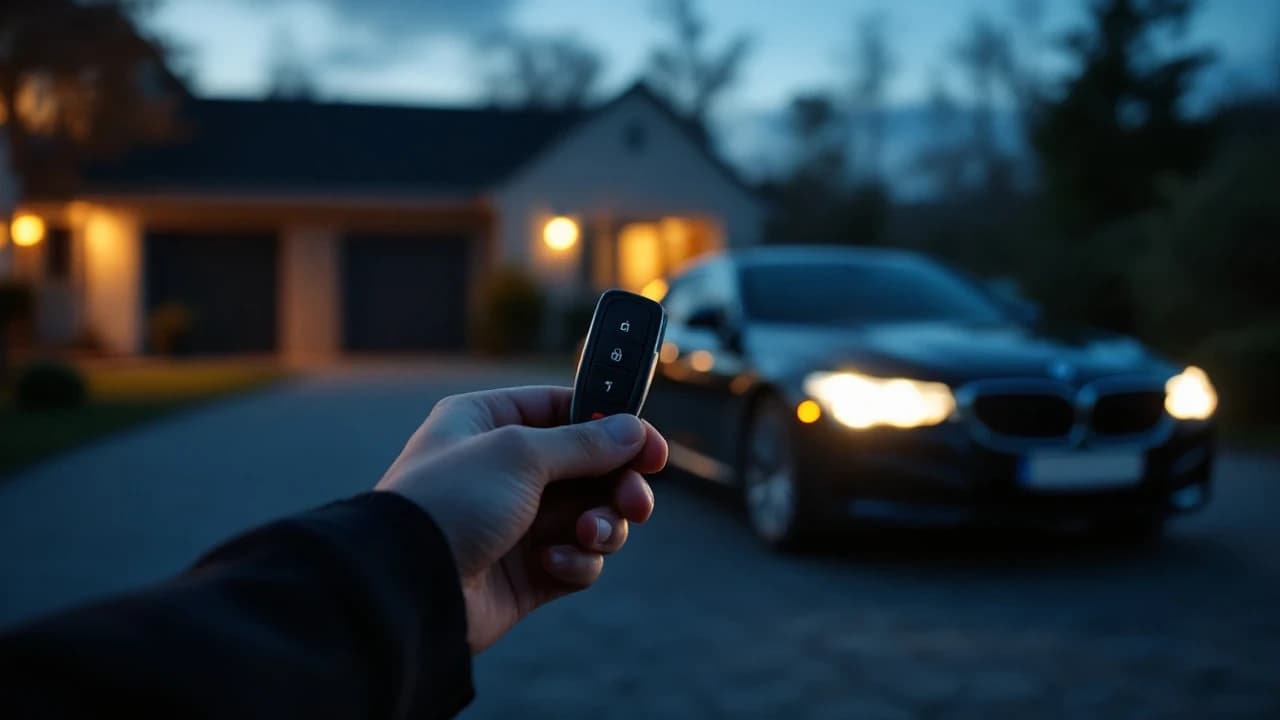
The doors unlock when you press the button. The lights flash. You get in, press the brake, press the start button or turn the key — and nothing, or a click, or a dash message, or a crank that never catches. The natural conclusion is that the key has died. It almost never has, and that is the most useful fact on this page.
On a modern European car the key does two entirely separate jobs. One is radio: the buttons, the proximity entry, the locks. The other is authorisation: a short encrypted conversation between a chip in the key and the car's security module, which decides whether the engine is allowed to run. A fob that locks and unlocks the car has proved that the radio side is healthy. It has proved nothing about the authorisation side.
That split is what this guide is built on. It lists the likely causes in order of how often we meet them, gives you a ladder of checks you can do in a driveway without tools, and tells you what each outcome costs in Dallas–Fort Worth as of October 2026 so you know what a fair number looks like.
As of October 2026. Costs are planning ranges for the DFW service area, not quotes.
Radio side versus authorisation side
Think of the key as a person with two badges.
- The radio badge opens the doors. It runs on the fob's battery and its radio transmitter. It fails when the battery dies, the contacts wear or the buttons crack. When it fails, the doors stop responding, but the car will usually still start if you hold the key against the right spot.
- The authorisation badge starts the engine. On many cars it is a passive chip that needs no battery at all. It fails when the chip is damaged, when the car's reader is faulty, or when the module that checks it has lost its data or its pairing.
Your symptom — doors respond, engine does not — is the opposite of the common battery failure. It points away from the fob and toward the car, or toward the chip inside a healthy-looking key.
The likely causes, in order of how often we see them
1. The transponder chip inside the key has failed
The doors work because the radio is fine. The chip that authorises the start has died, usually from a drop, water, heat or simple age. The tell: a second key starts the car without trouble. If it does, the car is healthy and the first key is the fault. This is a straightforward replacement, and it is the cheapest correct answer.
2. The car cannot read a healthy key
A coil or antenna near the ignition or start button reads the chip. If it fails, the car cannot read any key, including a good one. The tell: every key fails the same way, and the fault often comes and goes. This is the case in which owners buy a new key and the symptom remains. We cover it in detail in key not detected: antenna ring and coil faults.
3. A low or marginal car battery
The most overlooked cause, and the cheapest to check. A car battery that can still unlock the doors and light the dash may not have enough voltage to run the security modules and crank the engine at the same time. Several European platforms handle this poorly: the car is awake but confused, shows a security or drive-away message, and refuses to start. If the car sat for a while, or the battery is five or more years old, start here. Our guide to European cars that will not start after a battery change covers the related case in which the battery was just replaced.
4. The pairing between modules has been lost
The ignition module, the engine controller and the body module each hold a piece of the key relationship. If a battery event, a repair or a module swap leaves them disagreeing, the car refuses to start with a security message even though the key is perfect. On BMW this often presents as Drive-Away Protection Active. On Mercedes it is the family of messages in our Mercedes start error guide.
5. A failing ignition or security module
The module that holds the key table can corrupt, wear or take water. The tell: intermittent starts that get worse over weeks, a security light that behaves oddly, and sometimes a second key that works on Monday and not on Tuesday. This is a repair, not a key purchase. Our European module programming cost guide prices it.
6. A mechanical or electrical interlock
The car is waiting for something unrelated to the key: the brake-light switch, the gear selector reporting Park, a column lock that has not released, or a clutch switch. The key is innocent, and so is the security module.
A driveway diagnostic ladder
Do these in order. They cost nothing, and each one removes a candidate.
- Try your other key. If you have one. A second key that starts the car makes the first key the problem and ends the investigation.
- Read the dash. Write down the exact message. "Key not detected", "Drive-away protection", "See operator's manual", "Steering lock" and a security light are five different faults, and the wording is the single most useful clue you have.
- Check the car battery. Do the headlights dim hard when you press start? Did the car sit unused for a week or more? A weak battery produces some of the strangest immobiliser behaviour there is.
- Hold the key where the car expects it. Many cars have a backup position for a key with a flat battery or weak signal — a marked spot on the dash, console or column. Your owner's manual shows it. If the car starts from that spot, the fob's radio is the weak link, not the chip.
- Check Park and the brake. Confirm the selector is fully in Park, press the brake firmly, and try again. A dirty or misreporting selector can mimic a security fault.
- Note whether it is consistent. An intermittent fault that clears if you wait and try again is a strong sign of a reader, battery or module problem rather than a dead chip.
- Stop. If none of that changes the picture, further attempts do not help and a handful of repeated tries can drain the battery that is already marginal. Call.
Do not try to program a key yourself with a generic programmer from the internet. A failed write on a European car can corrupt module data and turn a $300 problem into a much larger one. Our failed key programming recovery guide explains what the cleanup involves.
What each outcome costs in DFW
Planning ranges as of October 2026. They line up with the rest of our pricing: the metro-wide DFW car key replacement cost index and the per-platform pages linked above.
| Cause found | Mobile (DFW) | What it means |
|---|---|---|
| Weak or faulty car battery | Diagnostic $90–$150, plus the battery | The cheapest correct answer; no key work needed |
| Fob battery or worn contacts | $200–$450 for a repair or reprogram | Radio side only |
| Key chip failed, car and module healthy | $300–$600 for a European spare, when a working key exists | A real key replacement, correctly diagnosed |
| Antenna ring or reader coil failure | $300–$500, priced as module work | The key was fine all along |
| Ignition or security module fault | $300–$500 for a repair, more if the module is replaced | Module work, priced separately |
| All keys lost | $400–$900, depending on platform | Security data read from the car first |
| Diagnostic read of the key and module chain | $90–$150 | Usually credited toward the repair |
Brand patterns worth knowing
BMW. A car that unlocks and then refuses to start often carries a drive-away or key-related message. After a battery event or a module repair, the security link between modules is the leading suspect rather than the key. The generation of the car decides the repair path; our BMW chassis-code decoder sorts it out from the model and year.
Mercedes-Benz. The ignition module, the steering lock and the key chain all take part in starting the car, so a failure in any of them looks like a key problem. If the wheel will not turn at all, the steering lock is the first suspect. Our Mercedes-Benz key system decoder maps each chassis to its generation.
Audi and Volkswagen. The immobiliser generation changes both the diagnosis and the price, and the security light behaviour is a useful clue. See the Audi immobiliser generation decoder.
Porsche. Newer models place more of the authorisation logic in modules that need Porsche-specific tooling. Our Porsche key system decoder maps each generation, and the Porsche key replacement cost guide prices the key side.
Why the wrong answer gets sold so often
A key is a tangible product with a price. A reader coil or a module data fault is an abstract diagnosis. A shop that sells keys will, naturally, sell you a key. If a key does not fix the problem, you have paid for it anyway, and the symptom is still there.
The defence is simple and costs less than the key: ask for a read of the key and module chain before anything is ordered. A shop that quotes a replacement key over the phone for a car that "unlocks but won't start" without asking whether a second key works, what the dash says, and whether the battery is healthy is not diagnosing — it is guessing.
When to stop and call
- Your second key does not start the car either.
- The dash shows a security or drive-away message that appears every time.
- The fault comes and goes over days or weeks.
- The car recently had a battery replacement, a module repair or a jump start.
- You have already tried a programmer or a "reset" you found online.
At that point the useful move is a diagnostic read, not another key. It takes less time than a phone call to three shops, and it removes the guesswork that makes the quotes so wide.
Frequently Asked Questions
Why does my key fob unlock the car but the car will not start?
Because the radio side of the key and the authorisation side are separate systems. The fob's radio unlocks the doors; a chip in the key, read by the car, authorises the engine. A fob can lock and unlock the car while the chip, the reader, the battery or the security module has failed.
Does this mean I need a new key?
Not necessarily. If a second key starts the car, the first key's chip has failed and a replacement is correct. If no key starts the car, the fault is in the car, and a new key will not fix it.
Could my car battery cause this?
Yes, and it is the most overlooked cause. A battery that can still unlock the doors may not supply enough voltage to run the security modules and crank the engine together, so the car shows a security message and will not start.
How much does it cost to fix in DFW?
As of October 2026, from a diagnostic read of $90–$150 up to a few hundred dollars for a fob repair, a key, a reader or a module repair, depending on the cause. All-keys-lost situations run roughly $400–$900 depending on platform. Planning ranges, not quotes.
Can I fix it by programming the key myself?
We advise against it. A generic programmer used on a European car can corrupt module data, converting a small problem into a module repair. Diagnose first.
Why does it work some days and not others?
An intermittent fault points to a reader coil, a marginal battery or a module on its way out, rather than a dead key chip. A dead chip fails every time.
Will the dealer fix it faster?
Not usually. A dealer visit normally means getting the car there, which can add a $150–$300 flatbed, and then a diagnostic fee. A mobile specialist reads the car where it is parked.
What should I tell you when I call?
Year, make, model and VIN, the exact dash message, whether a second key exists and whether it works, how old the car battery is, and whether anything was recently repaired.
Get a diagnosis before you buy a key
If your European car unlocks but will not start, the cheapest step is a read of the key and module chain. Not Your Basic Locksmith is licensed by the Texas Department of Public Safety Private Security Program and has specialised in European key and module work since 2012 — Arlington shop or mobile across Dallas–Fort Worth. Call (682) 344-1957 with your year, model, VIN and the exact message on the dash.