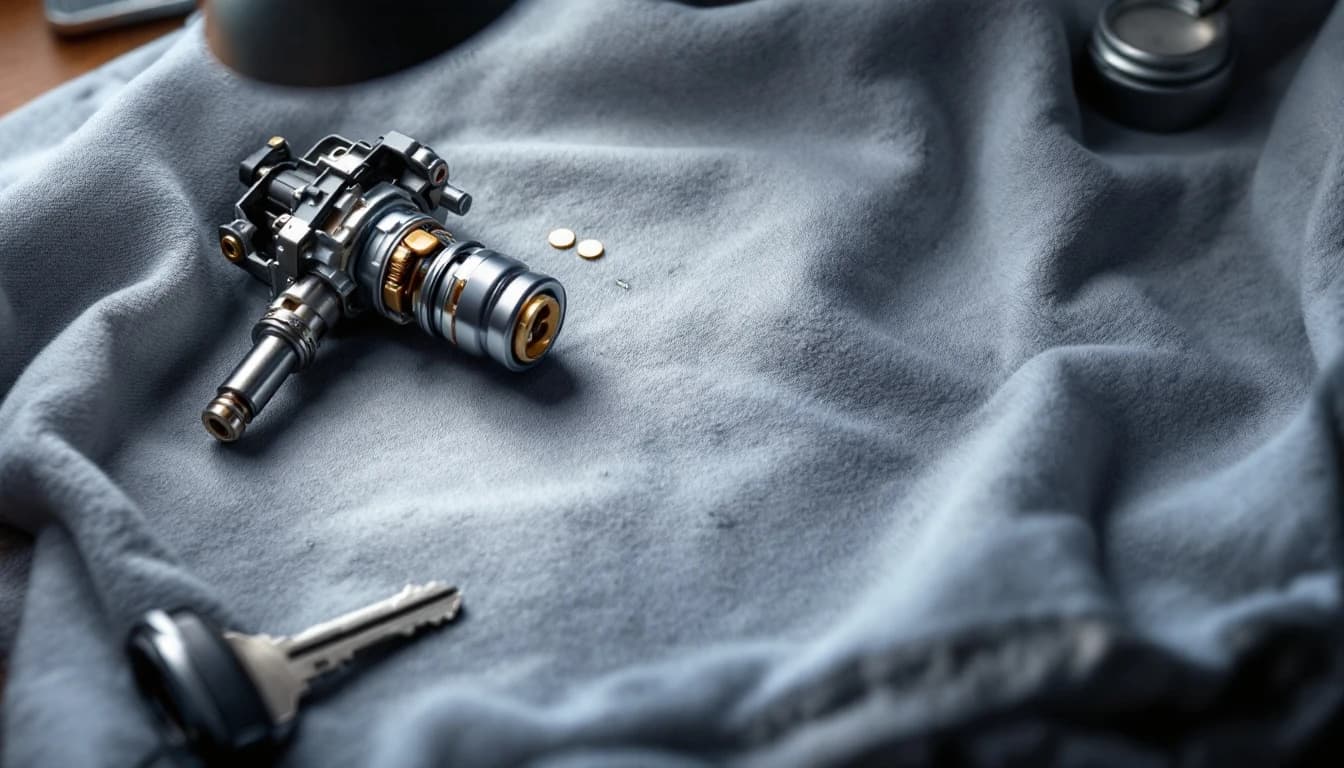
Porsche Ignition Lock or Steering Lock Fault
On a modern Cayenne, Panamera or Macan, the thing you turn to start the car is not a lock in the old sense. There is no cylinder full of wafers and no rod running down to the steering column. It is an electronic switch that asks a security module for permission, and a separate electric actuator in the column that locks and releases the steering wheel. When either one fails, or when the car cannot confirm the key, the driver sees one of a small family of warnings — an ignition lock fault, a steering lock fault, a key that is not detected — and a car that will not start, will not release the key, or will not unlock the wheel.
As of October 2026, working out which of those it is costs $90–$175 for a diagnostic read in Dallas–Fort Worth, against a typical dealer $250–$395. From there the fix ranges from a battery charge, through a $200–$450 key repair or reprogram, to a steering-lock actuator job in the $400–$800 band that applies to electronic steering locks generally. Porsche steering-lock and ignition-lock repairs are quoted from the VIN rather than from a table, because the part, the pairing procedure and independent access all change with the model year.
This page gives you the causes in the order we find them, the checks you can do yourself, and an honest account of where each one ends.
How the system works on these cars
Four parts have to agree before the engine starts.
The key. It carries a transponder that identifies it to the car and, separately, a radio transmitter for the remote and keyless functions.
The electronic ignition lock. The switch unit in the dash. On cars without keyless start you insert and turn the key. On cars with Porsche Entry & Drive, a fixed control sits in the lock and you turn that with the key in your pocket. Either way, turning it sends a request; it does not mechanically do anything.
The access and start authorisation. The module that checks the key, decides whether the request is legitimate, and tells the rest of the car.
The electric steering column lock. An actuator that engages a bolt in the column when the car is locked and withdraws it when a valid key is recognised. The car confirms the bolt has actually moved before it allows the engine to run — it will not let you drive off with the steering locked.
A fault warning means one link in that chain did not report what the car expected. The warning text narrows it down less than owners hope, which is why the surrounding behaviour matters more than the exact words on the display.
Which cars this covers
| Model | Generation | Approximate years | Notes |
|---|---|---|---|
| Cayenne | 958 | 2011–2018 | The most common of these calls in DFW |
| Panamera | 970 | 2010–2016 | Shares its electrical approach with the Cayenne of the same era |
| Macan | 95B | 2015–present | Closely related to Audi platforms of the period |
| Cayenne | 9YA | 2019–present | Newer architecture; quoted per VIN |
| Panamera | 971 | 2017–present | Newer architecture; quoted per VIN |
The six causes, in the order we find them
1. Low vehicle battery
By a distance the most common. These cars carry a heavy electrical load, and many of them sit for days between drives. When the battery is low, the steering lock actuator may not have the current to withdraw its bolt cleanly, and the security modules start reporting faults that have nothing to do with their own health. The dash may still light up normally, which is what makes this cause easy to dismiss.
The tell: the car has been parked for a while, the weather turned, or the last few starts were slow. Interior lights dim noticeably when you try to start.
2. A key the car cannot read
A weak fob battery on a keyless car means the key is not heard. A damaged transponder means the key is heard but not accepted. Either produces a no-start and often a key warning rather than a lock warning.
The tell: the second key works. Or the car starts when the key is used in the emergency procedure described in the owner's manual, which reads the transponder directly.
3. The steering column lock actuator
The actuator has a motor, a bolt and a position sensor. Any of the three can fail. Sometimes the bolt does not withdraw and the wheel stays locked. Sometimes it withdraws but the sensor does not report it, so the car believes the wheel is still locked and refuses to start even though the wheel turns freely. Sometimes it fails the other way and the wheel no longer locks, which the car also reports as a fault.
The tell: a steering lock warning specifically, a click that used to be there and is not, or a fault that comes and goes with temperature.
4. The electronic ignition lock unit
The switch itself wears. The classic signs are a key or control that will not turn, turns but does not spring back, or — the one that strands people — a key that cannot be withdrawn after the engine is switched off. A unit that fails to register "off" can also leave the car's electronics awake and flatten the battery overnight.
The tell: the fault is in the hand. It feels different, sticks, or will not let go, and it does so with every key.
5. The car does not know it is in Park
The key is only released when the car is satisfied the transmission is in Park, and starting requires a brake signal. A selector that is not registering its position, or a brake-light switch that has failed, produces a key that will not come out or an engine that will not crank — and it looks exactly like an ignition lock fault.
The tell: brake lights that do not work, or a gear display that does not show P cleanly.
6. A module or data fault
The least common, and the one most often blamed first. The authorisation module can lose data, be damaged by water or low voltage, or be left in a broken state by a programming attempt. A module replaced with a used unit that was never adapted to the car belongs here too.
The tell: every key fails, the problem followed electrical work or a previous repair, and other electronic functions are misbehaving alongside it.
Driveway checks before you call anyone
- Charge or test the battery first. If you have a charger, put it on. More of these calls end here than anywhere else, and no other check is reliable until the voltage is right.
- Try the other key. If it works, the car is healthy and the first key is the problem.
- Follow the emergency start procedure in the owner's manual. On keyless cars this reads the key's transponder directly and bypasses a weak fob battery.
- Take the load off the steering. If the wheel was turned hard against a kerb when the car was parked, the lock bolt is under pressure. Hold the wheel and ease it gently one way and then the other while turning the key.
- Confirm Park and press the brake firmly. Move the selector out of Park and back, then check that the brake lights actually come on.
- Write down the exact wording on the display and what the car does: wheel locked or free, key turns or does not, key releases or does not. That list is worth more than any guess.
What not to do: force the key, or keep cycling it. An electronic ignition lock is not improved by leverage, and a key broken in one is a second problem on top of the first.
From symptom to cause
| What you see | Most likely cause | Typical DFW cost (October 2026) |
|---|---|---|
| Fault after the car sat; starts are slow | Low battery | Charge or replace the battery |
| Second key works normally | First key | $200–$450 to repair or reprogram a fob |
| No working key at all | Lost or failed keys | $500–$1,100 all-keys-lost on European platforms |
| Steering lock warning; wheel stays locked | Column lock actuator | Electronic steering locks generally run $400–$800; Porsche quoted by VIN |
| Wheel turns freely but the car insists it is locked | Actuator position sensing | Quoted by VIN after the read |
| Key will not turn, or will not come out, with any key | Electronic ignition lock unit | Quoted by VIN after the read |
| Key stuck; brake lights not working | Brake-light switch or selector signal | Electrical repair, no security work |
| Every key fails after electrical or module work | Module or data fault | Module work, priced separately |
Why these parts are not a simple swap
On an older car, an ignition problem is mechanical: a worn cylinder, a worn key, a failed switch behind it. Replace the part and the job is finished. Our key won't turn in the ignition guide covers that kind of fault, and it is still the right page for most vehicles.
On these Porsches the ignition lock and the steering lock are part of the anti-theft system. The car knows which units it was built with. Fit an unintroduced replacement and the car treats it as a stranger: the part is physically correct, electrically connected and refused. A used unit from a breaker carries another car's identity and has the same problem with extra uncertainty about its condition.
That is the difference between a parts job and a pairing job, and it is why a general repair shop will often fit the correct part and then send the car to a dealer to finish. It is the same pattern we describe for the Audi cars that share this engineering in Audi steering lock failure, and for the wider family of faults in when a European ignition problem is really a module.
What we do when we arrive
We measure before we diagnose. Battery voltage at rest and under load. A reading that is low enough ends the visit with a battery recommendation rather than a repair.
We read the fault memory across the modules involved. The authorisation module, the column lock, the body electronics and the engine controller each keep their own record. Read together, they say which link reported the failure and which merely reacted to it.
We test each key directly. This separates a key that is not heard from a key that is not accepted.
We check the inputs. Park signal, brake signal, the position feedback from the column lock.
Then we price the specific repair. With the cheapest viable route named first, including when that route is "this is your battery."
If the car is already at a shop that has fitted a part and cannot get it accepted, that is a call we take regularly. The part may well be fine. It needs introducing to the car, not replacing again.
Module work, if it comes to that
When the read points at the authorisation module or at lost data, the job moves from ignition repair to module programming. That work is priced on its own sheet: the bands for European control modules are in our European module programming cost pillar, and controller-level Porsche work is covered in Porsche ECU programming.
If a previous programming attempt left the car worse than it found it, stop there and do not retry. What a failed write leaves behind, and what can be recovered, is set out in failed key programming recovery.
When the dealer is the right call
Three situations. A car still under a warranty that covers the failed component. A fault addressed by a recall or a manufacturer campaign — worth a phone call to a Porsche dealer with your VIN before paying anyone, because steering and ignition components are exactly the kind of part manufacturers issue campaigns for. And the newest architectures, where independent access to the security system for a given model year may not exist yet. We will tell you on the phone which side of that line your car is on, before anyone drives out.
For everything else, the work is done where the car sits. That matters more on these cars than on most: a Cayenne with a locked steering column cannot be rolled onto a flatbed without skates or a lift, and the tow alone runs $150–$300 before any repair begins.
Frequently Asked Questions
What does an ignition lock fault mean on a Porsche Cayenne?
It means the car did not get the response it expected from the electronic ignition switch or from the authorisation behind it. The cause may be the switch unit itself, a key the car cannot read, low battery voltage, or a missing Park or brake signal. The message is a symptom shared by several faults, not a diagnosis.
Why is my Porsche steering wheel locked and the car will not start?
Either the electric column lock did not withdraw its bolt, or it did and failed to report it. Low battery voltage is the most common reason for the first; a failed actuator or position sensor is the usual reason for the second. Check the battery and take the load off the steering before assuming the actuator has failed.
Can a weak battery cause a steering lock fault?
Yes, and it is the most common cause. The actuator needs clean voltage to move its bolt and the security modules report faults when the supply sags. A car that has sat unused should have its battery charged and tested before any part is condemned.
Why will my key not come out of the ignition?
Usually because the car does not believe the transmission is in Park, the brake signal is missing, or the electronic ignition lock has failed to register the off position. Check the selector and the brake lights first. If the key is stuck with everything else correct, the lock unit is the likely fault.
Can I replace the steering lock or ignition lock with a used part?
Not as supplied. Both are anti-theft components and a used unit carries the identity of the car it came from. A replacement has to be introduced to your car, and whether that is possible with a used part depends on the model year.
How much does it cost to fix in DFW?
As of October 2026 the diagnostic read is $90–$175, against $250–$395 at a dealer. A fob repair or reprogram is $200–$450. Electronic steering-lock actuator repairs generally sit in a $400–$800 band, with Porsche work quoted from the VIN because the procedure changes with the model year.
Does the car have to be towed to the dealer?
Usually not. Diagnosis and most repairs are done where the car sits. The exceptions are warranty or campaign work and the newest model years where the pairing requires the manufacturer's own access.
Start with the battery, then call
If the car has been sitting, charge it before anything else — it is the cheapest fix on this page and the most likely one. If the fault survives a healthy battery and a second key, it needs reading. Not Your Basic Locksmith has specialised in European key, ignition and module work since 2012, and is licensed by the Texas Department of Public Safety Private Security Program. Arlington shop or mobile across Dallas–Fort Worth — call (682) 344-1957 with your model, year, VIN and exactly what the display says.